

A Tuesday With Nothing on It
The biological case for canceling the next activity and replacing it with nothing
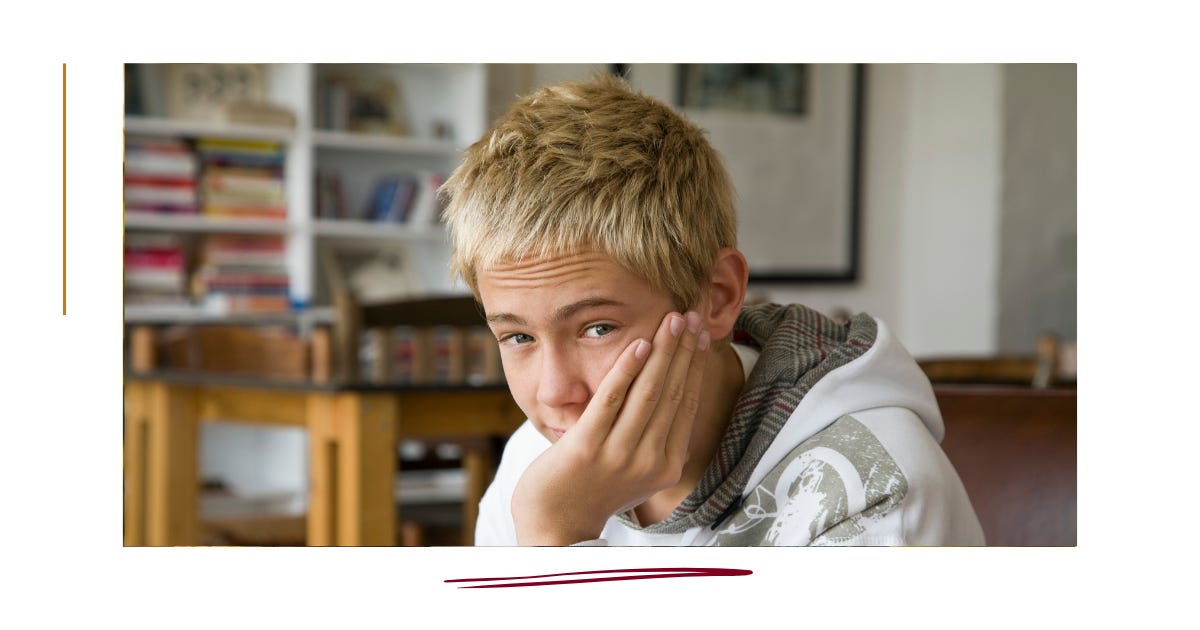
The most exhausted parents I know run the fullest calendars.
But what has a chance to grow when you stop filling the gaps?
For most parents of teenagers, especially parents above age 45, this is an uncomfortable question.
Here’s what I observed. And what science says:
Last week I sat in a Swiss living room with a group of parents of teenagers. Good, hard-working, responsible people. People who clearly love their kids.
The conversation was more like a logistics report.
Think: Maersk or Lufthansa transport entities.
Who drives where on Tuesday?
Which training is at what time?
Which friend’s birthday is this weekend. And what gift to make?
Which music lesson got rescheduled.
Every hour of every week, planned. Every gap, filled. Wet dreams of a productivity fanatic…
The promise behind the full calendar
The logic sounds solid.
A busy kid is a happy kid. An engaged kid is a safe kid.
An occupied kid doesn’t fall into the wrong crowd and doesn’t spiral into screens.
So caring parents organize, coordinate, and drive.
They keep the family calendar busier than that of an S&P 500 CEO.
And if you’re in your late 40s or 50s and your children are between 10 and 16, the stakes feel even higher. You waited. You invested.
Time, career, comfort - everything!
You are certainly not going to drop the ball now.
I watched those same parents over several days. They were exhausted.
Not from anything dramatic. From the relentless low-grade effort of keeping everyone, everywhere on time.
One mother told me she hadn’t read a book in four months. “I’m just too tired. Too many things to coordinate.”
And the teenagers?
They moved through it all like customers at a Marriott’s Sunday buffet.
Cherry-picking what they wanted. Ignoring the rest. Expecting the next option to appear… and it always did.
Freight parenting
I call it freight parenting. The family runs like a shipping company, and the parents are the fleet.
Jonathan Haidt documents the cost in The Anxious Generation (2024). First as a book, today as a fast-growing movement.
The idea behind:
The play-based childhood began disappearing in the 1980s.
Overscheduling became one of the main ways parents block the very experiences their children need most: risk, uncertainty, boredom, and the chance to figure something out without adult supervision.
His research links the collapse of unstructured time to the rise of anxiety and depression in adolescents across the Western world.
In that Swiss living room, the calendar was full, and nobody was resting.
The kids were constantly stimulated. Nobody had a minute for “senseless” thinking. The family was together at every moment, but nobody was alone long enough to know what they actually felt.
Just stressing through the routine program because it’s a normal Thursday…
What the eagle knows
You know me. I try to find sense in Nature.
I don’t know when you last saw an eagle.
But believe me: An Eagle Mama hunts for hours.
Her young sit alone in the nest, sometimes half a day. No wild animal schedules its young into permanent stimulation.
With good reason!
Boredom is not a problem to solve. It is a biological state with a function.
Neuroscience calls it the Default Mode Network: when the brain stops processing external input, it switches into reflection, imagination, and self-regulation.
This is where identity gets built. Where a young person starts to understand what they want, fear, and value.
Wait, what?? Read that again: This is where identity gets built. Where a young person starts to understand what they want, fear, and value.
A child who is never bored never activates that network long enough to develop it.
Thinking a moment about that and suddenly a lot of “modern-day” issues make a lot more sense, right?
The uncomfortable part of boredom
Here is what nobody says out loud: parents fill those calendars as much for themselves as for their children.
Watching your child lie on the floor doing absolutely nothing is uncomfortable.
It looks like failure.
It looks like your job isn’t done.
Especially parents who had children later in life carry extra weight here. Less margin for error, they think. More has to go right.
So they fill the time.
And they train their children unknowingly to expect that every discomfort will be removed before they have to sit with it.
The parents’ exhaustion and the teenagers’ buffet behavior are the same violation, seen from two sides.
Hand the hour back
There were parents I’ve met who knew about this research. And that was the advice they gave. A simple strategy they’ve tested countless times.
And it worked wonders.
Let one afternoon a week stay empty.
No plan, no ride, no activity booked. Tell your child: “You have a few hours, figure it out.”
Be consequent. Sounds hard. It’s not.
They will complain. Hell ya.
That is fine.
Discomfort is not damage. Boredom needs to be tolerated long enough to do its work.
Peter Gray, the evolutionary psychologist behind Free to Learn, spent decades studying this.
His conclusion: children with regular access to unstructured, self-directed time become more
emotionally resilient,
more socially capable, and
better at solving problems as adults.
The skills come from the emptiness.
Before you fill the next gap in the calendar, ask three things.
Is this activity for my child, or for my peace of mind?
What would happen if we simply canceled it and did not replace it?
When did my child last spend two hours with no instruction, no screen, and no plan?
According to research as we’ve discovered here, they don’t need another Tuesday activity.
They need a Tuesday with nothing on it.
If this way of thinking belongs in your week, Midlife Regeneration is the publication where I write about this kind of stuff. One article at a time. Always Regenerative.
The Campfire Council inside this publication exists for something different.
Not content, but connection.
If you want to work more closely, ask questions directly, and be part of a small group that takes this seriously: that’s what the Council is for.
Let’s regenerate the world - starting with yours!
Talk soon,
Daniel
This was such a needed reminder. As a parent, I’m learning that not every open hour has to be filled or rescued. Sometimes one meaningful thing is enough, then the rest of the day can stay soft.
I’ve started telling my kids, “We don’t have to do anything right now.” Let the body breathe. Let the brain rest. Take a walk. Float through the day without needing to hold on to everything.
It sounds small, but it feels like a quiet way of giving childhood back to them, and peace back to the house. 🤍
Daniel, “freight parenting” gives this essay a memorable name for a rhythm many families recognize: the calendar becomes the system, and the parents become the fleet. The Swiss living room scene works so well since it moves from logistics into formation, asking what teenagers lose when every empty space gets filled before boredom can do its work. The biological argument lands with practical force through the Tuesday invitation, where restraint becomes a parenting choice rather than neglect. Thank you for pressing parents to consider whether constant activity is protecting their children or quietly training them away from reflection, resilience, and self-direction.