

Are You a Victim of Self-Abandonment in Business Relationships?
The Quiet Betrayal We Don’t Talk About

Hi, I’m Daniel, the founder of SanaTerraFarm and the writer behind The Fearless YOU newsletter.
Like a lot of people, I used to chase success the way the world told me to — until a heart attack in 2018 forced me to rethink everything. That’s when I started searching for a way to live and work more in rhythm with Nature and myself.
For the past two years, I’ve written a daily newsletter exploring those ideas, and I’m now working on a book that distills them into a practical framework — what I call the Regenerative FARMISH Mindset.
My mission is to help exhausted professionals and overachievers stop abandoning themselves for ‘success,’ and instead design lives and businesses that actually regenerate their health, energy, and confidence.
I do this by sharing simple, regenerative principles from Nature, coaching people through a 12-week program called The Return, and creating resources that help them realign with authenticity, purpose, and sovereignty.
“I bend my business to fit what clients or investors want—even when it feels wrong.”
“I feel like I’m working in someone else’s business, not mine.”
If either sentence makes your chest tighten, you know what I mean: self-abandonment.
It’s the quiet betrayal that happens not in one dramatic moment but in a thousand small compromises. On the outside, everything looks fine. You're proud. Clients are happy, invoices and employees are paid. Lead generation and projects keep rolling in. All perfect.
But inside?
The spark that once made your business yours begins to fade. Faster and faster, like a roller coaster at the fair.
Laura’s Story: The Freeze at the Networking Event
Laura, 46, started her marketing agency in Romania with a burning fire in her belly. She wanted to help eco-brands thrive. Her work was rooted in values. You know the really big words. And she meant every one of them.
Sustainability, integrity, long-term impact.
But times got tough. And she found an investor to secure long-term growth. He quickly said, “Eco-brands are nice.” But if you want to grow, target more mainstream clients.”
Laura knew it didn’t feel right, but she agreed. One project turned into five. Before long, she was managing campaigns for fast-fashion retailers. The exact industry she once vowed to resist.
At a recent networking event, someone asked her the simplest of questions: “So, what does your agency stand for?”
She froze.
Tears welled up in her eyes as she told me about it.
The words that once rolled off her tongue—words that had made her proud—were gone.
The vision had been traded piece by piece until nothing was left but a hollow shell.
Laura hadn’t just abandoned her niche. She had abandoned herself. A fatal mistake. And she's not alone!
The Red Flags of Self-Abandonment
If Laura’s story feels familiar, here are the signals that usually show up first:
Constantly reshaping offers or messaging to keep others happy. More compromises on the table than during the renovation of a 100-year-old house.
Original vision watered down. Or worse - forgotten.
Guilt or hesitation when describing what you do. Body language speaks volumes...
Identity confusion: “Is this even my business anymore?”
Physical tension, dread before work, creeping burnout. Weekends seem to become shorter every month.
These signs show your business isn’t truly you anymore. Instead, it’s a cage made from your own compromises.
Wolves in Captivity: The Natural Parallel
In the wild, wolves are fierce and alive. Their instincts are sharp and non-negotiable. Their energy comes from doing what they were made to do—hunt, roam, and live in packs. And shaping entire ecosystems like we saw in Yellowstone National Park.
But place a wolf in captivity, and everything changes.
It stops hunting. It paces the cage, restless and uneasy. It adopts behaviors no wild wolf would ever display.
Yes, the wolf survives. But at what cost? The wild spirit that made it powerful disappears.
That’s exactly what happens when you abandon your business authenticity. You may survive. You may even “succeed” by external standards.
But the instinct, the vitality, the truth of who you are… fades.
The Psychology of Self-Abandonment
This isn’t just a metaphor; it’s been studied and named for decades.
Carl Rogers – Incongruence (1951)
When your outer actions (what you do, build, say yes to) don’t align with your inner truth (values, beliefs, instincts), you enter incongruence.
On the surface, you keep functioning.
Inside, stress rises.
Over time, your nervous system sends alarms: anxiety, fatigue, even physical illness.
Your body knows when you’re lying to yourself.
Abraham Maslow – Blocked Self-Actualization (1943)
Maslow’s hierarchy is more than a pyramid. It’s a truth about human growth. You can’t climb if you abandon authenticity.
Without alignment, you get stuck.
You may have money, respect, or recognition, but you remain restless and unfulfilled. Yes, even unable to step into your full potential. This is why high-achievers often whisper at 2 a.m., “Why do I feel so empty?”
Erik Erikson – Identity Crisis (1950)
Identity isn’t fixed—it develops through stages. When outside pressures, like investors, partners, or clients, take over, you face an identity crisis.
The person you wanted to be clashes with the roles you’re forced into.
A split occurs: part of you plays along, while another part quietly mourns.
Eric Berne – The Adapted Child Role (1964)
Under pressure, we regress. Berne's Transactional Analysis explains how we often become the Adapted Child. We say yes to authority to dodge conflict or rejection.
In business, that means silencing your sovereignty.
You become obedient, agreeable, a pleaser.
But inside, resentment builds.
The Mechanism: How the Erosion Happens
Self-abandonment rarely starts as a conscious choice. It unfolds like erosion.
Small, almost invisible shifts until the landscape becomes unrecognizable.
External pressure: Investors or clients push their agendas.
Fear of loss: You worry about losing income, reputation, or relationships if you resist.
Tiny compromises: One “yes” leads to another.
Erosion accumulates: You wake up one day running a business that doesn’t even feel like yours.
System breakdown: Burnout, shame, disconnection. The cost comes due. Often accompanied by sneaky, little health limitations.
Like the wolf pacing in its cage, you’re alive but no longer free.

The Cost of Staying in the Cage
Emotional: loss of passion, guilt, a hollow sense of “living a lie.”
Physical: constant fatigue, tension, and health breakdowns.
Business: diluted messaging, weak resonance with clients, lack of creative energy.
The cage might look like success from the outside. But inside, it’s draining you.
The Way Back – Regenerative Interventions
Authenticity isn’t a switch you flip. It’s a rhythm you rebuild.
Here are three layers of realignment:
Immediate Relief (1–2 days)
Write your original business vision in one sentence.
Identify one current project that betrays it.
Rhythm Reset (1–2 weeks)
Create a boundary statement: your non-negotiables.
Drop or redesign one misaligned service.
Speak your values openly in your marketing—see who resonates.
Deep Rewiring (1–6 months)
Rebuild your business ecosystem: offers, clients, and partnerships that fit your vision.
Practice sovereignty: say no even when money tempts.
Build a community of like-minded partners who reinforce your authenticity.
This isn’t about burning it all down overnight. It’s about planting back into the soil of who you really are.
A Companion for the Inner Work
Authenticity is not a luxury. It’s the lifeblood of a business—and a life—that lasts.
If Laura’s story moved you, or if you see the wolf in the cage, check out this resource by my friend Dr. Eboni L. Truss. You’ll want it.
It’s called When Success Isn’t Enough: 3 Simple Steps For High-Achievers to Reclaim Their Lives.
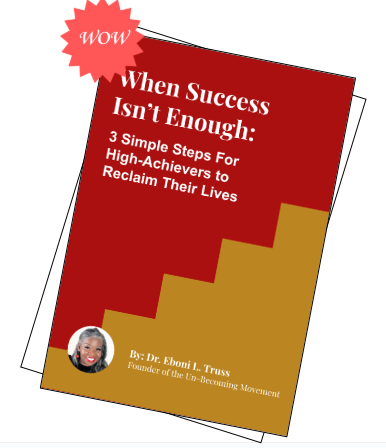
It’s a fillable workbook for ambitious leaders. It helps them reset, rediscover their true desires, and realign with those goals. This way, they can avoid the high cost of self-abandonment.
Because success without authenticity is just another cage. Stay out of it!
Stay fearless,
To your freedom and health,
Daniel