He Made It to the Parking Lot. That Was as Far as He Got.
What happens in your body when the future turns into a threat
Fear of the future is not a weakness. It is a very old protection system running hard on very bad data. The problem is not Paul. The problem is that his brain cannot tell the difference between a predator at the edge of the trees and a rumor from a cafeteria secretary.
At the end of this article, you’ll find a resource that helps to spot this hidden reactions Nature built to protect us. See you at the end :-)
The Parking Lot
Paul gets there on time. That part works fine.
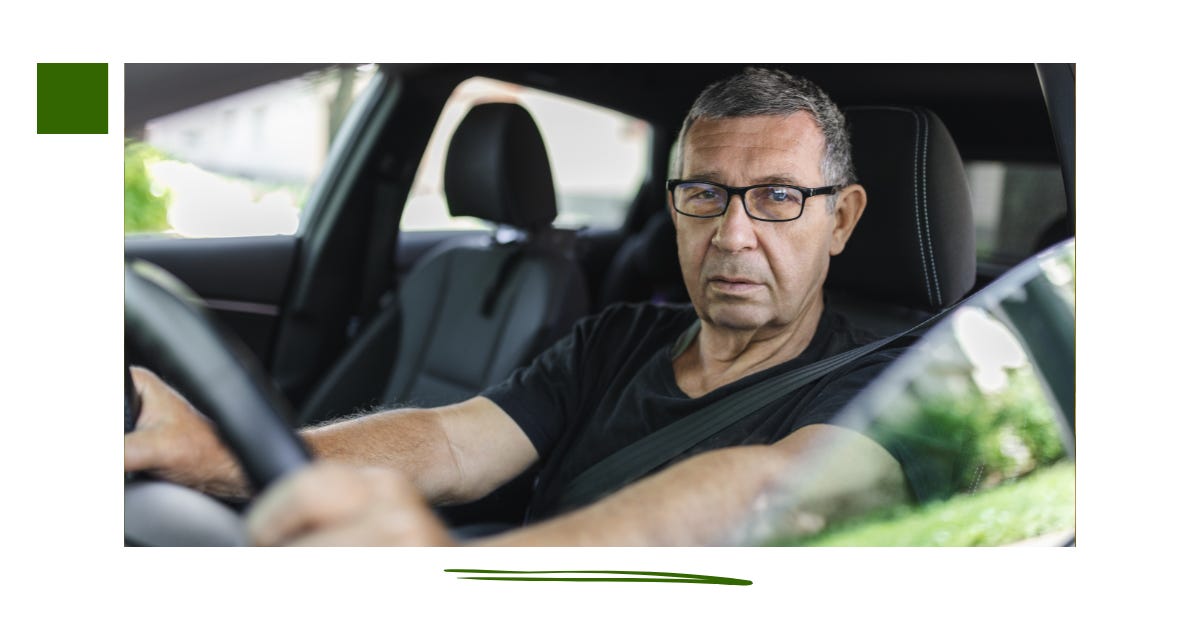
He drives the same route he has driven for eleven years. Signals right at the gas station. Pulls into his usual spot. Third from the end, where the hedge gives a little shade. Turns off the engine.
And then nothing.
He cannot open the door.
Nothing is physically wrong with his hand. His hand works. He can see the handle. He has opened that door maybe three thousand times.
But today, for reasons he cannot explain to himself, the door stays shut. Paul stays in the seat. The engine ticks as it cools. He watches two colleagues walk past without noticing him.
Yesterday in the cafeteria, he heard Sophia, the departmental secretary. She always knows things first. She spoke with the flat certainty of someone reading a weather report. “They’re getting rid of half of us.”
That was it. No names. No timeline. No source. Just the words, and then someone changed the subject, and the conversation moved on, and Paul carried those seven words home in his chest like a stone.
This morning, the stone is still there.
He sits in the parking lot. He is not crying. He is not panicking visibly. From the outside, he looks like a man checking his phone. From the inside, he is somewhere else entirely…
What Is Actually Happening Inside Paul
Here is the thing most people miss about fear: it does not feel like fear. Not the way movies show it.
Paul is not shaking. He does not have a racing heart. At least not yet.
What he has is something more like a slow drain. Energy leaves his body without going anywhere. The distance between his hand and the door handle feels enormous.
Not physically. Cognitively. His brain has decided, below any conscious decision, that the building across the parking lot is a threat.
That is the first mechanism: threat appraisal. His brain’s alarm system, the amygdala, is about the size of an almond and buried deep.
It processed yesterday’s information and reached a verdict.
Not a rational one.
Not a proportional one.
Just: danger.
The amygdala does not evaluate probability. It responds to possibility. Losing his income, identity, and sense of self is now seen as a threat.
When someone asks what he does, it raises concerns about who he really is.
So his body is preparing.
Not for a meeting. For a threat.
His adrenal glands have pushed cortisol into his bloodstream since roughly 3 a.m. Which is why he woke before his alarm and could not get back to sleep.
Cortisol is a stress hormone. It sharpens certain kinds of attention and dulls others. It tells the body: stay ready.
The problem is that “ready” looks different from “functional.” Ready means his muscles carry a low-level tension he cannot relax out.
Ready means his digestion has slowed because energy has been rerouted. Ready means his prefrontal cortex - the part that plans and sees the big picture - is partly bypassed by an older system that cares less about nuance.
This is why Paul cannot think clearly. It is not a character flaw. It is a hijack.
The Second Mechanism: The Thought Loop
Inside the car, his mind is doing something specific. It is not empty. It is full - but in one direction.
He runs the scenario forward.
If the cut is real, if it is my department, if it is my role specifically...
OMG. Mortgage. His daughter’s school fees.
The last time money was tight, he saw his wife’s worried face. He dreaded the conversation he needed to have with her.
His father’s disapproving look echoed in his mind. He had always said he should choose a more stable path.
The mind does not stop at if. It skips directly to when and builds the scene in detail.
This is called catastrophic forecasting.
The brain, under cortisol, is particularly good at constructing the worst version of a future scenario.
It does this not to torture you, but because rehearsing the worst outcome was historically a survival advantage when threats were physical and immediate.
You survived because you prepared for the worst. The brain learned that lesson very well.
The problem is that this threat is not a predator at the edge of the trees. It is a rumor from a secretary in a cafeteria.
Nobody knows anything.
The actual probability of Paul losing his job today is no different than it was a week ago. But his nervous system cannot hear that. His nervous system is running threat-response software that was written for a different world.
And so the loop runs.
Whenever he relaxes his thoughts - maybe Sophia was mistaken, maybe it’s another department, maybe this will pass - the amygdala sounds the alarm again.
And cortisol brings the worst-case scenario back into view. Because calm, in threat mode, feels like naivety. Like dropping your guard.
Paul’s brain is protecting him.
That is the cruelest part. All of this - the paralysis, the loop, the drain.
It’s just an act of protection. Running on completely wrong information…
What the Tree Knows
There is a tree outside my window right now. An almond tree, around 30 years. In February, before a single warm day arrives, it begins pushing energy toward its buds.
Not when spring comes. When the signal arrives, that spring might come. Day length. Temperature shifts. Internal chemistry responding to information.
The tree does not know whether spring will be cut short by a late frost. It cannot verify. It just responds to the signal.
Paul’s nervous system works on exactly the same principle.
Sophia’s words were a signal.
His body responded to the signal the only way it knows how: prepare. The difference is that a late frost is either coming or not. But the thing Paul fears is not a weather pattern. It is a rumor.
Unverified. Possibly wrong. Definitely incomplete.
The tree cannot second-guess its own chemistry. Paul can.
But only if someone helps him understand what is happening inside him, because right now, he thinks this is just him.
His weakness. His overreaction.
He is a little ashamed, sitting in the car for this long.
It is not weakness. It is a very old system, running very hard, on very bad data.
The Door Is Still There
At some point, Paul will open it.
Maybe in five minutes. Maybe in twenty.
Maybe he will start the engine and drive home, call in sick, sit with the weight of it for another day.
That is also a reasonable response to an unreasonable amount of cortisol before 9 a.m.
What he cannot do right now is think his way out of this.
Not rationally.
Not by telling himself to calm down or look on the bright side.
The thinking brain is not fully in charge at this moment. The older, faster brain is.
What actually helps - and this is not intuitive - is the body first. A few slow exhales, longer out than in. Both feet flat on the floor. A single, concrete question: What do I actually know for certain right now? Not the story. The facts.
What Paul knows: he drove to work.
He arrived. The door handle is within reach.
Nothing has changed since yesterday except a sentence he heard second-hand in a room full of rumor and anxiety.
The stone in his chest does not dissolve. But it gets a little lighter.
One step.
Not a plan for the week.
Not a strategy for the rest of his career. Just: the door handle.
The short walk across the parking lot. The knowledge that his nervous system is doing exactly what it was built to do. And that does not make him broken.
It makes him human.
If you suspect there is something bigger underneath the fear. Not just this week’s rumor but a deeper misalignment that has been building for years, then this might be designed precisely for you.

It makes the invisible visible. Not with a quiz. With a real written conversation.
What was the last time you sat somewhere and couldn’t move forward — not because you were lazy, but because something had grabbed you from inside?
I’m curious what that looked like for you. I read every reply.
“Let’s regenerate the world - starting with yours.”
Thanks for reading.
Yours,
Daniel