

How to Read a Handshake
Reading hands is a useful art

🌿The Fearless YOU helps millennials break free from self-doubt, build confidence, and take control of their health and natural future.
Ready to thrive?🌿
Dear fearless friends and readers!
Ever wondered what your handshake says about you—or the person shaking your hand?
Well, brace yourself!
Today's guest article is a bit different from my usual easy-to-digest bites—think less snack-sized and more gourmet science platter.
Bernhard Kutzler, a philosopher, mathematician, and numerologist with a remarkable journey from science and entrepreneurship to deep self-exploration, is here to take you deeper.
He once isolated himself for 3.5 years just to crack the hidden patterns that control our behaviors. (Talk about commitment!)
In this fascinating deep dive, Bernhard reveals how a simple handshake can reveal surprising insights about personalities and intentions. Enjoy this exploration—and don't forget to subscribe to Bernhard’s newsletter for more intriguing adventures into the mysteries of the mind.
Talk soon,
Daniel
Guest post written by Bernhard Kutzler
When you meet someone, it’s useful to know something about the other person, especially if you meet them for the first time. But even if you already know each other, it would be good to find out something about the other person’s current mood. Shaking hands can help you with this.
I’ll explain below what you can read from a handshake and how.
Everything speaks, because everything is interwoven. In the body, all tissues and organs are interconnected physicochemically and electromagnetically. Body and mind are also inseparably linked, as I explain in my articles “There is More Than Just the Universe” and “Why and How the Universe is an Illusion.”
Therefore, everything potentially shows up everywhere. Some areas of the body reflect the body and mind particularly well. These include the hands, feet, face, and eyes. That’s why there are arts such as foot reflexology, acupuncture, and also hand, face, and iris diagnosis.
40 years ago, I met a psychologist who was a master of hand diagnosis. I learned this art from him and it became a useful tool for me in dealing with people. At the end of the article, I explain why hand reading is not a future reading, but a serious diagnostic science.
To read another person via their handshake, you must learn to “take yourself out of the equation.” For example, if you grab a hand firmly yourself, you can’t tell much about how firmly the other person is grabbing your hand. Therefore, you should first observe yourself shaking hands ... in order to calibrate yourself.
The better you get at shaking a hand neutrally, the more accurately you can read a person’s handshake.
You also must include the context of the encounter in your interpretation. Is the other person your client? Is it a job interview? Is it about a business? Is it a romantic encounter? Etc.
Pay attention to the following signals when shaking hands:
How does the hand come towards you? Brisk? Energetic? Hesitant? ... You can transfer this to the person one-to-one.
How does the person grab your hand? Is their hand up, forcing your hand down? Is their hand down so that your hand is up? Or are your hands side by side?

An upper hand shows dominance and activity; a lower hand shows submission and passivity. If the hands are neutral next to each other, this is an encounter at eye level. With this signal, it is even more important that you offer your hand neutrally and observe what the other person does with it.
How firmly does the other person grab your hand? The spectrum ranges from strong, the “bone breaker,” to weak, the “dead fish”. Some people grab so strongly that your hand hurts afterwards. A firm grip is a sign of dominance and activity, perhaps even aggression. The “dead fish” is what the name implies; the person is passive and doesn’t want to reveal anything about themselves; they may be stingy, wait-and-see, or uninterested.
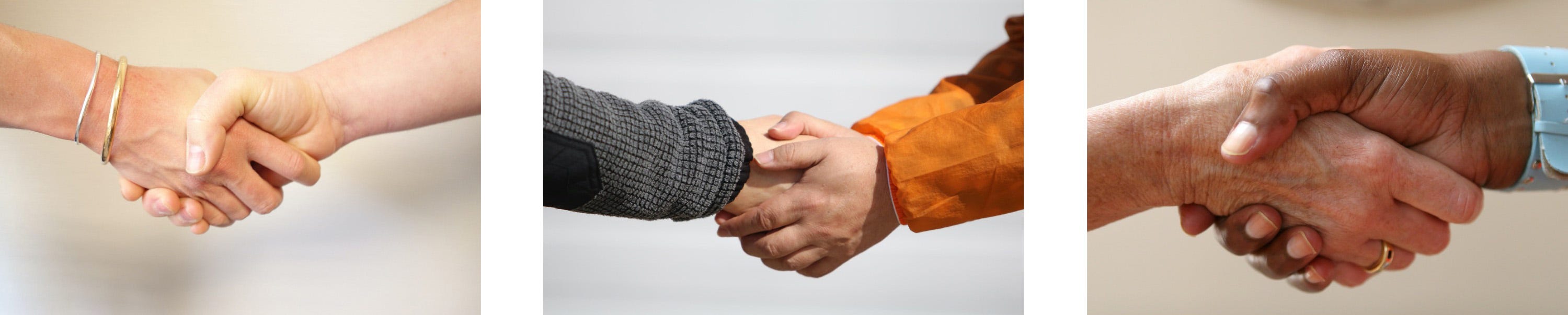
Does the other person lock your hand, the “vice”? The other person placing their thumb firmly on the back of your hand from above, while their four fingers hold the edge of your hand in place from below, can do this (left image); or the other person additionally clasps your hand with their second hand (middle picture); or the other person forces your wrist into a strong bend (right picture).
(p2)
(left image link: https://pixabay.com/photos/wrist-hand-appointment-alliance-2359761/)
(middle image link: https://pixabay.com/photos/wrist-hand-appointment-alliance-2359761/)
(right image link: https://pixabay.com/photos/agree-agreement-asian-black-1238964/)
These gestures rob you of your ability to move your hand; the other person controls the handshake – and, therefore, you. The “vice” is a gesture of dominance, activity, or aggression; however, it can also mean that the other person clings to you, eg because they need you or think they need you.
A handshake can be powerful or powerless, energetic or hesitant, subdued or exuberant. You also interpret this one-to-one.
As you shake hands, consciously feel the other hand. Is it muscular, fleshy, thin, lean? Soft or hard? Elastic or stiff? Moist or dry? Warm or cold?
• A firm, muscular hand is courageous, persevering, serious.
• A fleshy hand is content, comfortable.
• A thin, lean hand is hungry, thirsty, flexible.
• A soft hand is impressionable, influenceable, sensitive, vulnerable, yielding, adaptable; possibly capricious, dreamy, epicurean.
• A hard hand is unimpressionable, un-influenceable, strict, unyielding, determined, controlled, persevering, practical; emotional expressions may be inhibited.
• An elastic hand is adaptable, yielding.
• A stiff hand is rigid, unyielding.
• A dry hand is strict, dismissive, energetic.
• A moist hand is friendly, receptive, sensitive, nervous, excited, shy.
• A warm hand gives warmth and affection.
• A cold hand needs warmth and affection.
When is a hand soft? When is it hard? When is it stiff, when elastic? These are relative characteristics that you need experience to assess. To gain experience, you need to feel as many hands as possible.
Once you have identified the signals, you must combine their meanings – and this is the challenging part of the reading. Signals can strengthen or weaken each other. For example, an upper hand, which shows dominance and activity, can at the same time be a dead fish, which says the opposite. So you must take all signals into account – plus the context of the encounter.
Finally, there is the question of why someone is sending a signal. Let’s assume that the handshake contains several dominance signals. Is the person actually dominant, or just pretending to be? The dominance could be a mask, eg to hide a weakness or a feeling of inferiority. If you are afraid of something or someone, you want to dominate them in order to be in control. A self-confident and strong person doesn’t need to dominate.
Hand reading has a reputation among many as a fairground attraction where the future is predicted. This happens occasionally, but it is untruthful. In fact, hand diagnosis is a science that is also researched at universities.
A serious hand diagnostician will not predict the future; because you can’t. The simple reason is that the hand is constantly changing. As proof, here are two prints of a woman’s left palm – taken 20 months apart:
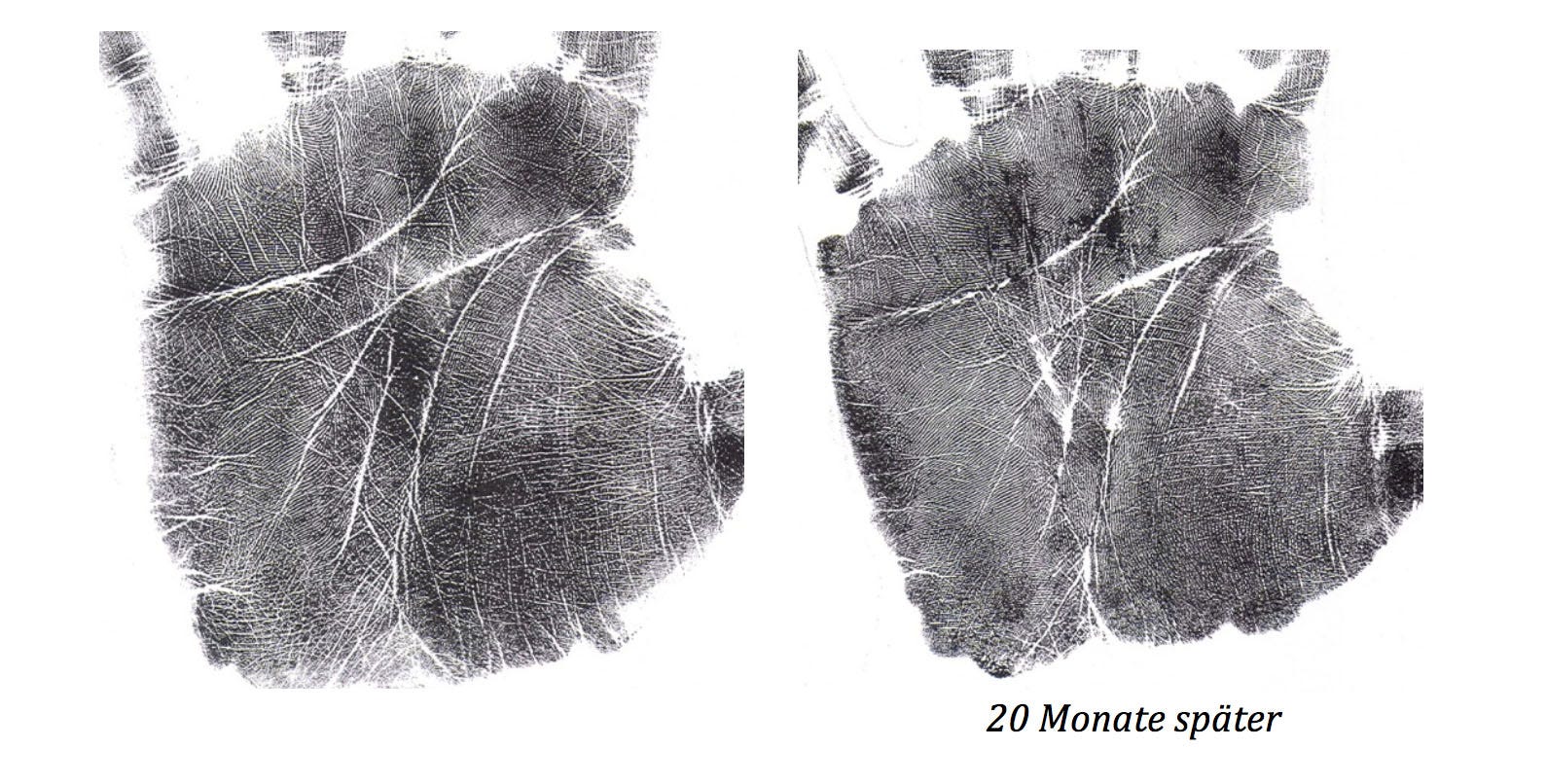
The line pattern has become much clearer. In this case, there are both physiological and psychological reasons for this.
The hands show a person in the present. They show what someone is made of, what is now, and what their potential is. If the person changes, physically or mentally, the hands change. Making statements about the future is like predicting the weather.
Practice experiencing a hand instead of just looking at it intellectually. An experience is infinitely richer than an observation. Reading a handshake – or a hand – requires experience. Gaining experience takes time. Start by reading your own hands and observing yourself shaking hands. Then move on to looking at other people’s hands and observing how they shake hands – and how else they move their hands.
Further reading:

“Why and How the Universe Is an Illusion”
(What is an illusion, anyway?)
This is fascinating to read. The idea that certain parts of a person present themselves everywhere.