
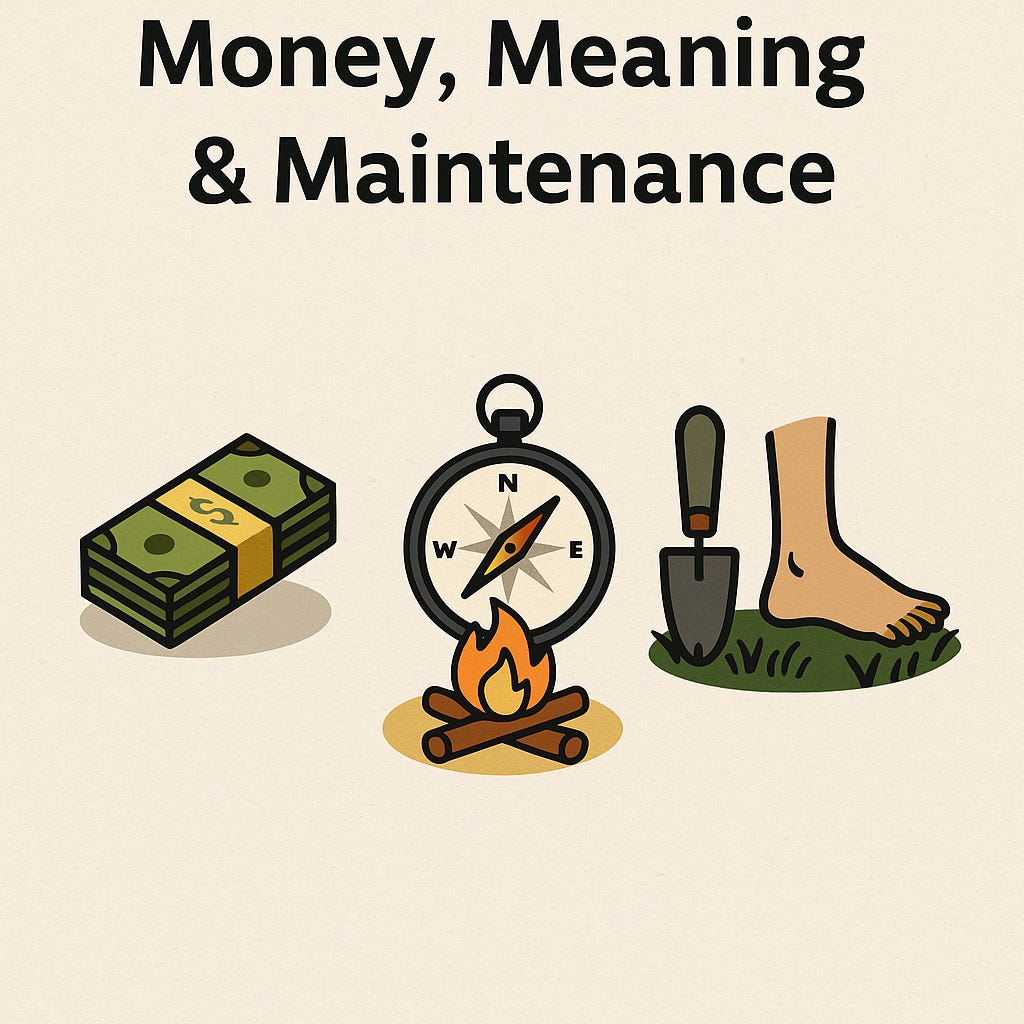
Money, Meaning & Maintenance: The Triple Bottom Line of the New Business Builder
The pitfalls in our modern lives that cost you more than you'd like to believe

There’s a saying I used to shrug off: “If you don’t make time for your wellness, you’ll be forced to make time for your illness.” I heard it, nodded at it, and moved on—until my heart attack made it impossible to move on from anything.
That moment reset my internal compass. Not just about food or stress, but about the foundational lie we all have been sold to. That sacrificing your health is an acceptable price to pay for success. No.
Together with other wrong-beliefs, this is fundamentally evil. The reasons are various, as you'll see in an instant.
But let's start with the biggest trap.
The Money Trap: Success That Costs You Everything
In my previous life, I did what most entrepreneurs do. I sprinted toward the idea of success. Build the company. Grow the brand. Employ the people. Push the limits. Sleep less. Smile more. Accept a lot.
But only much later I've learnt the truth about the pursuit of money: it’s rarely just about money. It's about proving something. To your family. To the market. To the ghosts of childhood that whisper “You’re not enough.”
Sometimes, with horrible consequences.
In post-communist Romania, where I live now, I’ve seen how deeply this mindset has rooted. People were raised to believe that having—not being—is the goal. For more than fourty years people learnt one thing: Stuff equals status.
A house with fences, two cars in the driveway, a phone for each kid. Two times holidays at the sea. I’ve met families with massive homes and multiple incomes who still feel miserable inside. They don’t move. They don’t rest. They don’t nourish their bodies. They just own.
Even in our rural village of 1,500 people, I am the only one who walks every day. Rain, snow, or sun, I’m out there. And the looks I get?
You’d think I was parading a goat on a leash while whistling the national anthem. (It's mostly just a dog!)
My in-laws shake their heads in disbelief. Neighbors watch in quiet jealousy, but no one joins. Why? Not because they’re too poor or too busy.
But because the system trained them to focus on everything else but themselves.
The Meaning Deficit: Why We Eat Lousy and Sit Too Much
You’d think it’s a matter of willpower. Eat better. Move more. You know it’s good for you. So why not do it?
The answer lies in how our brains work.
Modern neuroscience shows this undisputably. Decision fatigue, cortisol buildup, and a hijacked reward system make it extremely difficult to choose broccoli over dopamine-rich snacks.
Or a 30-minute walk, over another scroll through social media.
And when you're stuck in a loop of low self-worth, your mind defaults to comfort.
Junk food. Netflix. Noise. The path of least resistance. Because making aligned, healthy choices isn’t just a matter of knowing better. People often need to be aware enough to care.
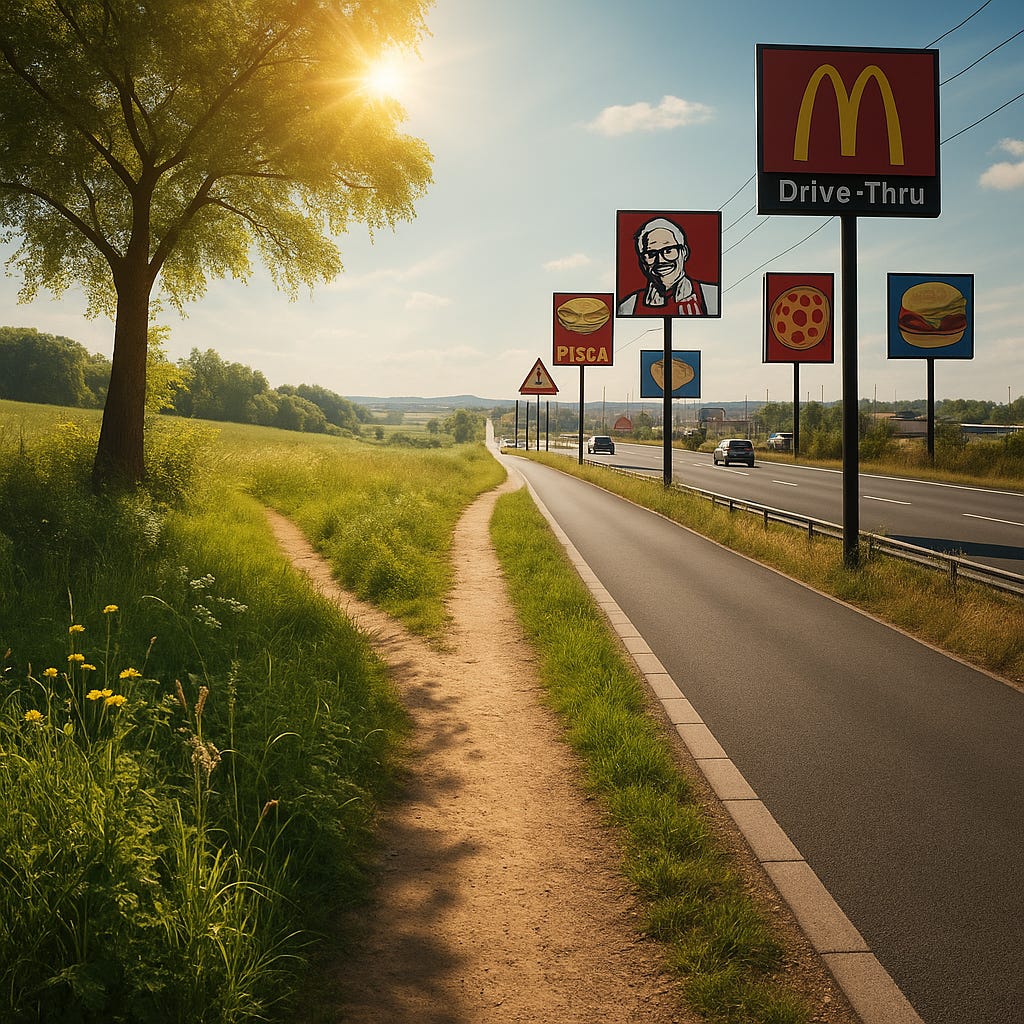
In cities, especially, the problem multiplies. Too many inputs. Not enough Nature. No silence. We're biologically built for sunrises, movement, and deep community.
But in reality? We live in boxes, drive through chaos, and consume processed light, sound, and food.
This is why people eat the way they do. Not because they’re lazy or stupid. But because the entire environment—and their nervous system—is trained to survive, not thrive.
And in this high-alert survival mode?
Well, success is measured in likes, launches, and LinkedIn endorsements. Not in how deeply rested you feel or how connected you are to your purpose. Obviously, we need different KPI's (Key Performance Indicators).
Maintenance: What Truly Moves the Needle
Back when I had employees, I trusted them more than they knew. And I assumed things that had not yet been covered in their training. Example?
I once stood up at our company's Christmas party and told with a convincing voice.
“Next year, whoever makes the most mistakes will get the biggest paycheck.”
They looked at me like I’d escaped from an asylum. Because the culture here doesn’t reward risk. It rewards obedience. Inherited from decades of communism, this belief is deeply ingrained: don’t do it wrong. Better don’t do it at all.
But here’s what I know now: a regenerative business isn’t built on avoiding mistakes. It’s built on recovering fast, learning faster, and having the stamina to keep showing up.
That stamina doesn’t come from hustle. It comes from rhythms.
I now live more minimalistic than ever. But I still want to simplify more. I’ve learned to prioritize conversations. With friends, community members, my family, and potential clients. I choose presence over productivity.
Silence over performance. A short barefoot walk over another checkbox on the Notion to-do list.
This is the kind of maintenance that matters. Not quarterly goals and metrics. But personal energetic maintenance. And enough context for people to understand your ideas...
The Bigger Picture: Why Regeneration Isn’t a Trend, It’s a Return
I’m not preaching this because I read it in a book. I’m living it.
And I see the same pattern in many of my readers. Millennials in their 40s, already feeling the biological tax of city or business life:
The back pain.
The poor sleep.
The creeping weight gain.
The mood swings. The brain fog.
None of these are random.
They are warning signals from a body that’s exhausted from a lifestyle it was never built for.
We weren’t made to grind 80 hours a week. We weren’t made to raise kids who never touch the soil. We weren’t made to trust pills more than sleep, or sugar more than sunshine.
And yet, we do.
Until something breaks. For me, it was my heart.
That’s why I created The Return. It’s not a course. It’s not a hack. It’s a 12-week safe space to help you rebuild your life from the roots.
Maybe you feel like your body is whispering “enough”. Or you know something deeper is calling. Or you’re tired of managing symptoms and want to start living again:
Let’s rebuild something real, starting with your rhythm.
Thanks for reading!
To your freedom and health,
Daniel
PS: I’m not here to convince anyone. I’m here to walk every morning, even if I’m the only one. If that resonates, you’ll love what we’re doing next.