

The 7 Stations of a Man's Regeneration. Almost Nobody Reaches the Last One.
Burnout took a great photographer to the edge. What he did next maps the whole climb of a man’s regeneration, all the way to the summit almost nobody describes.

You’re sitting somewhere familiar.
The coffee’s there. The day has started. And yet something isn’t.
You’ve done everything right by anyone’s standard. But the question that keeps surfacing, the one you dismiss before breakfast, isn’t going away.
I write about that question. Every week. For people in midlife who’ve stopped pretending it isn’t there.
If that’s you, you’re in the right place.
He was standing on the land where he was born, and it was dead…
Red dust where once a forest thrived in every shade of green you can imagine.
Bare hills the color of old brick. Dead. Lifeless.
The springs his father knew as a boy had stopped running years ago.
Sebastião Salgado had come home to Minas Gerais. To the family farm in the Rio Doce valley in Brazil, because he had nowhere else to go.
His body had quit on him. Not slowly. It had shut the door…
He was one of the most respected documentary photographers alive. For years he had pointed his camera at the worst of what people do to each other.
Famine in the Sahel. War.
And then, in 1994, Rwanda, during and after the genocide.
He came back from that assignment and his body started sending signals that something was very, very wrong. He fell ill.
He sank into a deep depression. Doctors could find the symptoms but not a single mechanical fault. He thought about putting the camera down for good.
He was, in the honest sense of the word, finished. Broken.
So there he stood. A depleted man on depleted ground. Both of them stripped down to the same red dirt.
Most people would call that the end of a story.
It was the beginning of the most important one he ever lived.
The wake-up nobody chooses
I know that bare ground. Not Salgado’s - mine.
At 51, I had a heart attack. Not a warning shot, the real thing.
I had spent decades chasing the less secure path, paid some prices, mostly won, and somewhere along the way I stopped listening to the one instrument that never lies.
My body had been sending the same message for years.
I kept translating it into something easier to ignore.
The heart attack was not a punishment. It was a wake-up. The trigger event that a man cannot argue with.
For Salgado, it was his health collapsing after Rwanda.
For another man, it is the divorce papers on the kitchen table. Or the last child leaving and the silence that follows. Or a business he built for twenty years that suddenly means nothing to him.
Or just a dread at 3 am that will not go away. The shape changes. The sentence underneath is always the same.
- Something is wrong, and now I can’t ignore it anymore. -
Wait! This publication stays free because people like you share it. Some articles ended up in inboxes I would never have had access to on my own! It’s what makes my regeneration lived practice. The best share is with your husband, your colleagues, your buddy, your brother, or your neighbour.
The welcome email includes a gift. I started to send it out when I already had 800+ subscribers. Chances are, you never received the gift. If you want it, leave a comment or DM me. I’ll send it to you with pleasure.
- Something is wrong, and now I can’t ignore it anymore. -
That is milestone #00 zero
The base camp of every man’s regeneration.
And here is the first thing almost nobody tells you: a man does not climb because he decides to.
Rarely!
He climbs because staying where he is finally costs more than moving.
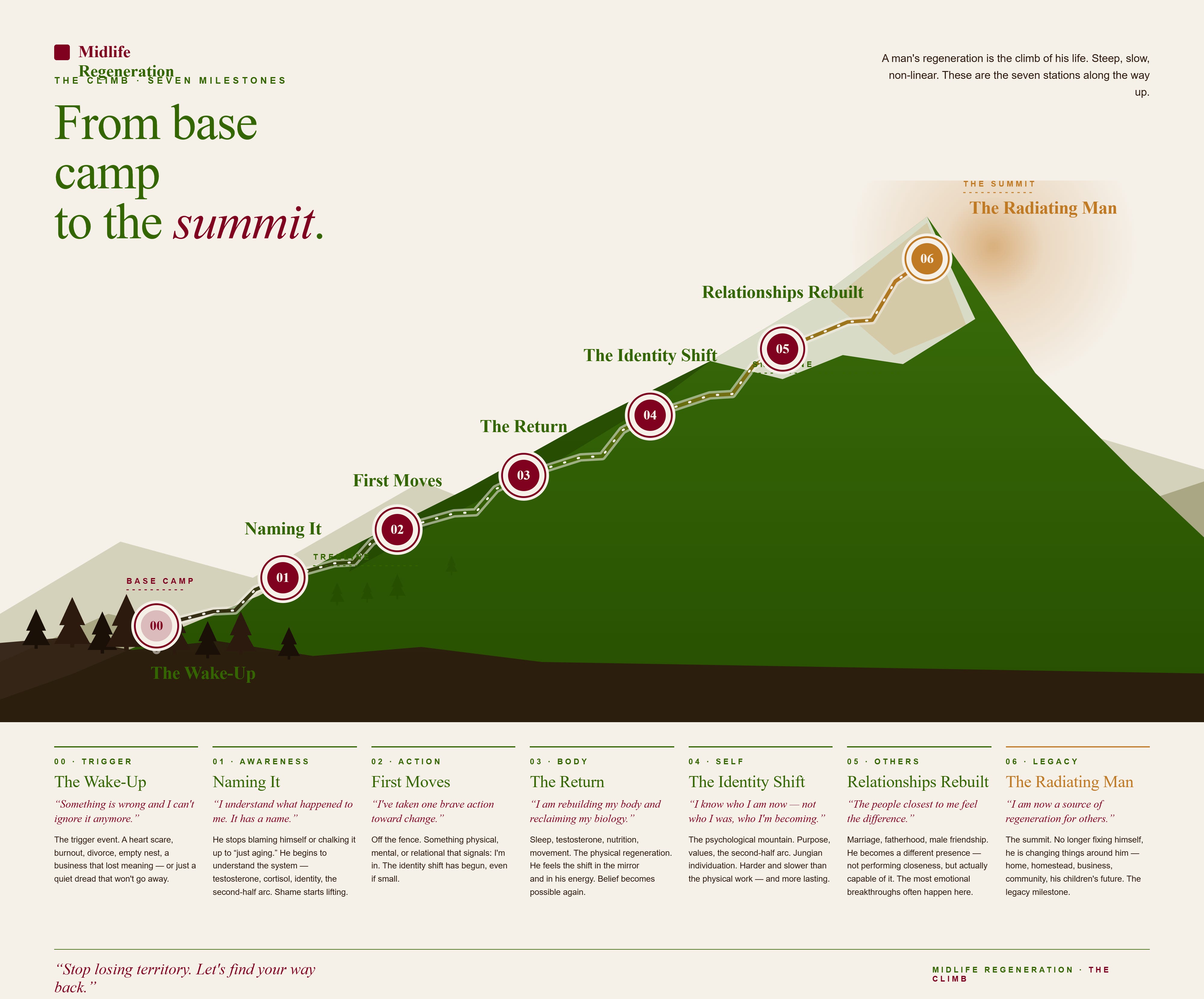
The Climb. Seven stations from the wake-up to the man who becomes a source of regeneration for others.
I want to walk you up this mountain.
Not as a motivational hike. As a map.
Because I have watched enough men get stuck at exactly the same ledges, and I’ve met the rare ones reach the top.
And the top is the part we never talk about.
We are going to spend most of our time up there. At the summit.
The stage where a man stops fixing himself and becomes an example others want to follow. The legacy stage.
But you cannot understand the summit without the climb, so let me take the stations in order, and let Salgado climb them with us, because he happened to climb every single one in plain sight.
Station #1: naming it
The first move up from base camp is not action. It is understanding.
A man who has just been knocked down usually does one of two things.
He blames himself, calls himself weak, decides he has lost his edge.
Or he waves it away as “just getting older” and pours more coffee.
Both keep him frozen.
Naming it is the moment the shame starts lifting. He learns what actually happened to him.
Testosterone that has been sliding for a decade. Cortisol stuck in the on position from years of low-grade stress. A nervous system that has been running a famine program while sitting at a full table.
The second-half arc that every man walks and almost no man is warned about.
Salgado named his.
What broke him was not weakness. It was that a human being is not built to absorb that much horror and stay whole.
His exhaustion had a cause. And the land in front of him had a cause too. It had been cleared, grazed, and mined until the living layer was gone.
Neither the man nor the ground was broken by accident.
Both had been depleted by extraction that never gave anything back.
Extraction.
That is the whole diagnosis in one word.
Something takes and takes and never returns, and eventually the system that was feeding it goes quiet. It is true for soil. It is true in a marriage. It is true of a man’s own body.
When you can name the mechanism, you stop fighting yourself. You start reading the signals instead of overriding them.
Station #2: first moves
Then comes one brave action.
Small. Physical, mental, or relational. The thing that signals: I’m in.
For Salgado, it did not even start as his idea. His wife, Lélia, looked at the ruined family land and said something close to: what if we plant the forest back??
Not a plan. A first tree.
They planted it. Then another. And one more…
That is the whole of milestone two.
A man off the fence. He has done one thing that his old self would not have done, and the ground has shifted under him.
Even though nothing outside looks different yet.
I have watched men wait years for the perfect plan before they take the first step.
The soil does not wait for perfect weather. A seed does not hold a committee meeting. It takes one drink of water and starts. The first move is not the strategy. It is the water.
Station #3: the return to the body
Then the physical rebuild.
Sleep.
Nutrition.
Movement.
Getting the machine running again.
This is where belief comes back, because this is the first station where a man can see the change in the mirror and feel it in his energy.
For me it was 30 kilos gone and, at age now 59, being in better shape than I was at 40. For the land it was literal. Salgado and Lélia did not plant a garden.
They started an ecosystem.
And ecosystems do not rebuild in one move. They rebuild in stages.
Ecologists call it succession.
On bare, wounded ground, the first things to grow are the tough pioneers, the plants we dismiss usually as just “weeds”. They cover the wound. They shade the dirt and protect what little life is left underneath from the same sun that is baking it.
Only once the pioneers have done their unglamorous work can the bigger, slower species take hold. And only much later does anything like a canopy appear.
But guess what?
A man’s return works the same way.
The first habits are ugly and basic. Walk. Sleep. Eat like an animal that lives inside its own design.
They are not the summit yet. They are the pioneer plants covering the wound so the real growth has somewhere to stand.
More than two million trees went into that valley over the following years.
Hundreds of native species. The pioneers first, then the rest, in order, the way the land itself decided.
Station #4: the identity shift
Now the hard one. Harder than the body, and much slower.
The man who started climbing was the climber. Exhausted, reacting, surviving.
The man arriving at station four is somebody else. He knows who he is now. Not who he was, but who he is becoming. He’s literally on a mission. On HIS mission.
Salgado could have stopped at a healed body and a few thousand trees.
Instead, something in him turned. He had spent his life as the man who photographs human suffering.
Somewhere on that ruined farm he became the man who grows life back. Same person. Completely different center of gravity.
This is the psychological mountain.
Purpose,
values,
the second-half arc.
It is the least visible station and the most permanent, because a rebuilt body can slide back but an identity that has actually shifted does not.
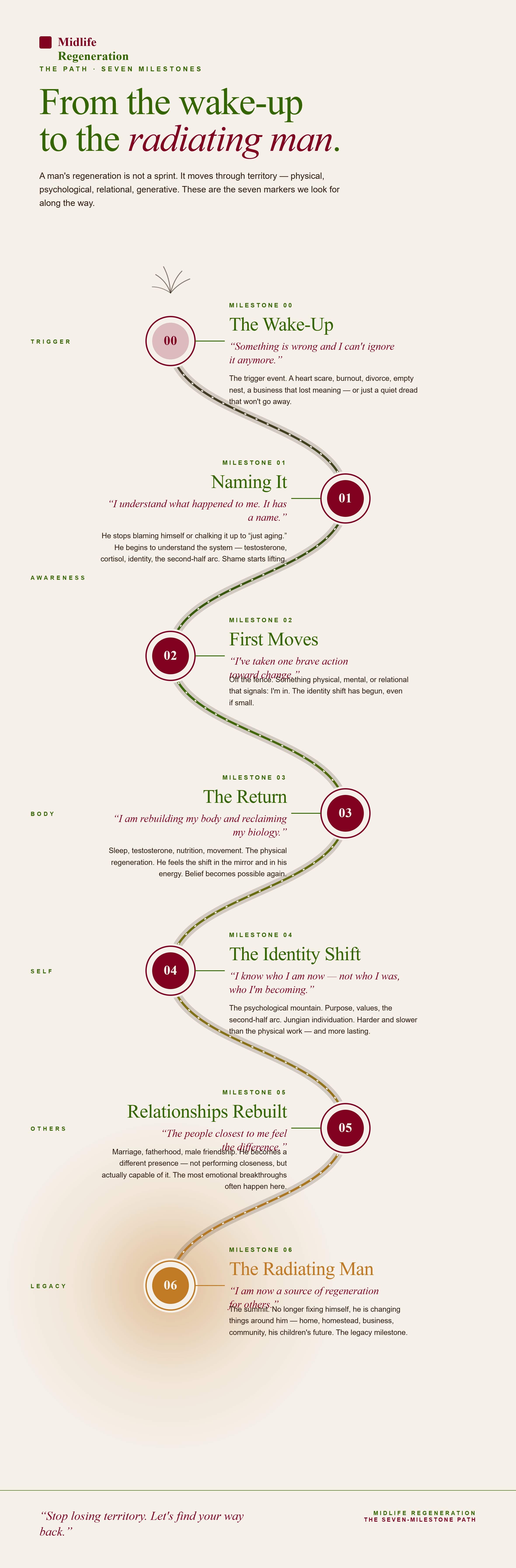
The same seven stations, drawn as the winding path they actually are. Nobody climbs this in a straight line.
Look at the path in that image, because it matters. It is not a staircase.
It bends back on itself. Men slide from station three to station one and start again. That is not failure.
That is how living systems move. A river never runs straight. It finds the shape of the ground.
Station #5: the people closest to him feel the difference
Before the summit, one more.
A regenerated man becomes a different presence in his closest relationships. Not performing closeness, actually capable of it. His marriage feels it. His kids feel it.
The one or two men he can call at midnight feel it.
This is where the most unexpected breakthroughs happen, and it is where a lot of the earlier work gets tested. A man can rebuild his body alone.
He cannot rebuild trust alone. That takes another person willing to meet him.
Salgado’s rebuild was never a solo climb.
It was him and Lélia, side by side, planting a forest that would outlive both of them. The closest relationship was not a casualty of the work.
It was the engine of it.
Here is a natural law worth sitting with.
An isolated tree stands alone against every storm, with no shared roots to hold it.
A tree in a forest is tied underground to the ones around it through a fungal network, and through that network the trees move water, carbon, and warning signals to each other.
Foresters have found that the older, bigger trees pass resources to the younger and weaker ones, especially their own kind.
The forest is not a collection of individuals competing for light. It is a connected system that keeps its members alive.
Human resilience works the same way. It is relational.
Self-reliance taken too far becomes self-isolation, and the isolated man breaks in the first real storm.
Station five is where a man reconnects his roots.
The summit, #6: the radiating man
Now we are at the part almost nobody writes about.
Every self-improvement story you have ever read stops at station three or four.
Fix the body, find the purpose, roll credits. Get your energy back, get your confidence back, and the story is apparently over.
Why is that?
Because the story is not over. There is a whole stage above it, and it is the reason the climb exists at all.
Reaching the summit, a man stops fixing himself.
He is no longer the project.
He becomes a source of regeneration for others.
He changes the things around him.
His home.
His work.
His community.
His children’s future.
He becomes the man other men watch from a distance and think, I did not know it could be done, and now I have seen it done.
This is the legacy milestone.
And it usually arrives by accident.
Salgado never set out to become an environmental figure.
He just intended to get well.
But in 1998 something turned that healing outward. He and Lélia did not keep their forest as a private cure.
They founded an institution, Instituto Terra, on that same land. (Link at the end)
They built a seedling nursery that would grow millions of native trees.
Not only for their farm but for the whole degraded valley around them. They started training young people, students, and local farmers to do what they had done. The private healing became a public seed bank.
That is the moment a man crosses from station four to station six.
It is not when he feels better. It is when his getting better starts producing life in other people, whether he is in the room or not.
The land in that remote valley in Brazil came all the way back.
Springs that had been dry for decades began to run again. Insects returned, then birds, then larger animals.
The reforested farm became a protected private reserve. And Salgado said, in the years after, that he had been reborn along with the forest.
He died in May 2025, at 81.
The trees are still there. The nursery is still running. The young people he trained are still planting. That is what a summit looks like.
He left, but the regeneration did not. It multiplied itself many times…
Why we never talk about this stage
Three reasons, and they are worth naming, because they are the same three reasons most men never reach it.
The first is that our whole culture stops the story at the personal win. Lose the weight, land the promotion, feel confident again.
That is where the marketing ends, because that is where the product got sold. Nobody is selling you the stage after the stage, because the stage after the stage cannot be sold to you. You have to give it away.
The second is fear. To radiate anything, a man has to be visible. He has to stand for something and let people see him do it. Which in consequence means letting people see him possibly fail.
I know that fear from the inside. The question that sat in me for years was, “Who the hell are you to tell the world how things should be?”
Salgado could have kept his forest quiet and safe. Standing up and saying to a whole region, “you can do this too,” is the braver and more exposed thing.
Most men choose the quiet forest.
The third reason is the deepest. Men think the summit is about them.
They think legacy means
being remembered,
a name on a building,
a number in a bank account for the kids.
So they either chase it as ego or dismiss it as vanity. Both miss what it actually is.
Legacy is not what you leave.
It is what keeps growing after you stop tending it.
That is a different thing entirely. A statue does not grow. A trust fund does not grow, it just gets spent.
A forest grows. An institution that trains people grows.
A child who watched his father regenerate his own life grows.
Real legacy is a living system you set in motion that does not need you to keep running.
What Nature already knows about legacy
Here is the biology that governs the summit, and it is not decoration. It is the actual mechanism.
In a healthy forest, the oldest and largest trees are not the greediest.
They are the hubs.
Through that underground fungal network I mentioned, a mature tree feeds sugars and nutrients to the seedlings growing in its shade, the ones that cannot yet reach the light on their own.
The big tree does not need those seedlings. It feeds them anyway.
And when that tree finally falls, it does not stop giving.
It becomes a nurse log on the forest floor, slowly breaking down, feeding the next generation from its own body. Nothing leaves the system. Nothing is wasted.
The old feeds the new, in life and in death.
That is the radiating man, described in wood and fungus a hundred million years before we had a word for it.
A younger tree cannot do this. It has nothing spare.
It needs everything it makes just to keep climbing toward the light. Only a tree that has already made it up, that has roots deep enough and a canopy wide enough, has surplus to send downward.
The capacity to feed others is not a personality trait. It is a stage of maturity.
You reach it, or you do not, depending on how far up you have climbed.
This is why the summit cannot be faked nor rushed.
A depleted man has nothing to radiate.
He is still running everything he generates just to stand up.
Only a regenerated man has surplus, and surplus is the whole point. The forest does not ask the mature tree to feed the seedlings.
It just does it, because that is what a system with more than it needs naturally does.
There is a second law underneath this one, and it changes how the whole climb feels. You do not have to power the regeneration yourself.
When wounded soil starts to heal, the man who owns the land does not force it.


A seed takes one drink of water and releases signals into the ground.
The microbes already living there answer, feed compounds back, and the two of them start a cooperation that neither one runs.
Nobody manages it. The repair sequence was built into the land the whole time. The farmer’s only job is to get water to the seed and then step out of the way.
A man at the summit works the same way.
He does not carry other people up the mountain.
He cannot, and trying it is how good men burn out a second time.
What he does is add the one small thing that wakes the capacity already sitting in someone else!
And then he gets out of the path.
He is just the water, not the engine. Salgado did not grow two million trees with his own hands.
He created the conditions, planted the first pioneers, and the forest did what forests do…
Where you actually are on the mountain
You are somewhere on this climb right now. Every man is.
The question is whether you can see which station you are standing on, because you cannot plan a route without knowing your actual position.
This is where I use a tool I built from twenty years of watching natural systems and human ones fail in the same ways.
I call it the FARMISH blueprint.
It is a way of finding where a human’s life is out of alignment, and which natural law he or she is violating in that spot, because that is always where the pain is actually coming from…
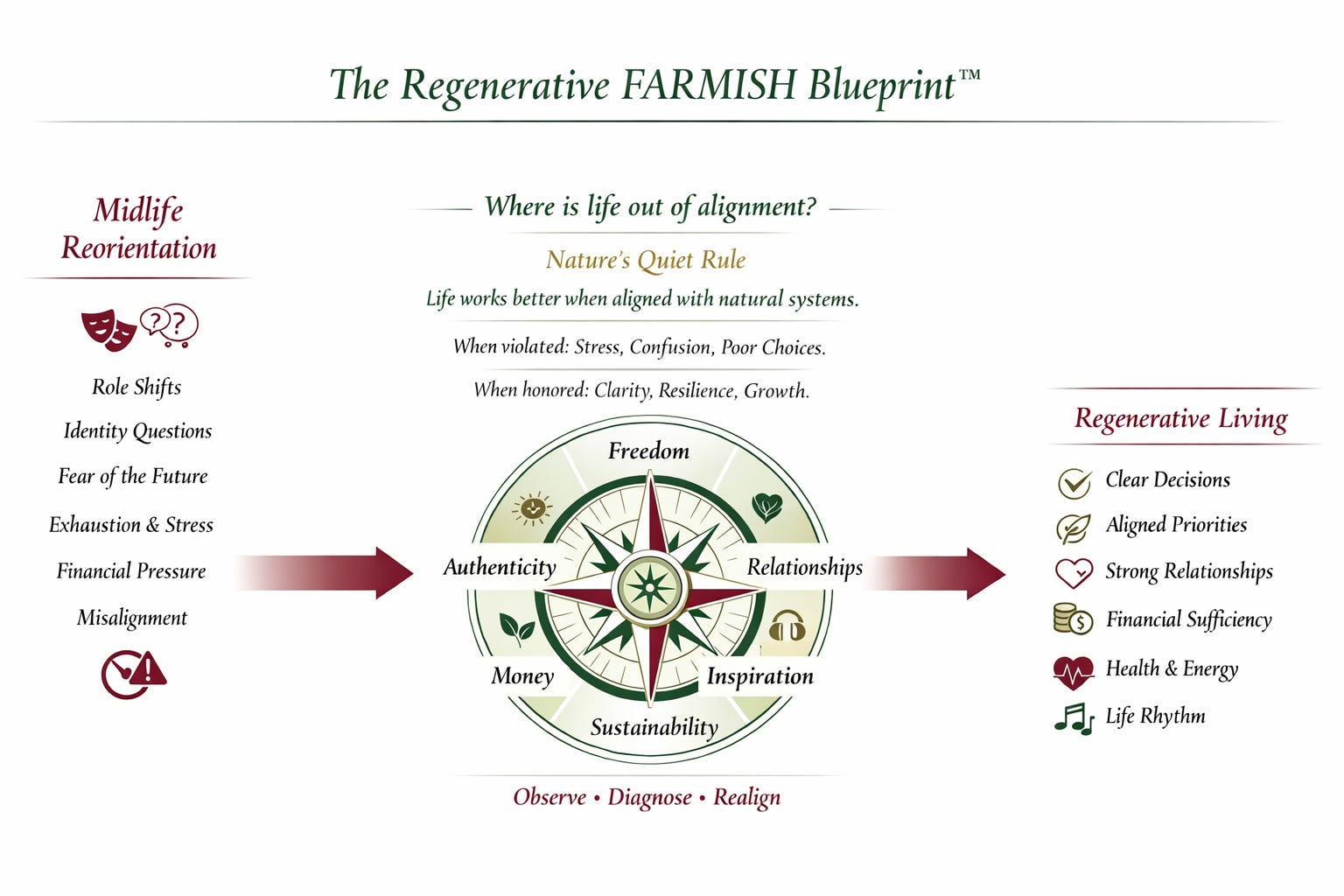
Where is life out of alignment? Seven segments. One quiet rule underneath all of them.
Seven segments:
Freedom,
Authenticity,
Relationships,
Money,
Inspiration,
Sustainability,
Health.
Everyone’s exhaustion, fog, and drift traces back to one of these being out of line with how living systems actually work.
Watch how Salgado’s climb runs straight through all seven.
His Health collapsed first, the way it usually does, because the body is the one instrument that will not keep lying for you.
His Inspiration had been strip-mined, summer after summer of witnessing horror with no winter to recover, which is exactly how creative burnout works: soil farmed with no fallow season.
His Authenticity shifted when he stopped being only the man who documents suffering and became the man who grows life.
His Relationships carried the whole rebuild: him and Lélia, roots tied together.
His Sustainability turned from a career that was consuming him into an institution designed to outlast him.
His Freedom returned when his days stopped being dictated by the next assignment and started following the seasons of the land.
And his Money, the farm itself, went from a dead asset to a living reserve that produces value every year without being strip-mined to do it.
Nature’s quiet rule sits under all of it.
Life works better when it is aligned with natural systems.
Violate the rules and principles, and you get stress, confusion, paired with poor decisions.
Honor it, and you get clarity, resilience, and growth.
A man does not need more willpower. He needs to find the segment where he is fighting his own biology, and stop.
That is the whole diagnosis:
Observe.
Diagnose.
Realign.
Not force. Realign.
The step, if you want one
You do not need to plant a forest.
You do not need a heart attack, and I would not wish mine on you!
Here is the one move that starts the climb, and you can do it this week.
Pick the single segment of those seven where you feel the most drag.
The one that made you flinch a little as you read it.
Then.
Do not try to fix it. Just watch it for seven days, the way a farmer reads his land before he touches it.
Notice one decision in that segment you are about to make on autopilot, and before you make it, ask a single question: is this my choice, or the choice I was trained to make?
That is the water on the seed.
It is smaller than you think and harder than it sounds.
You are not adding effort. You are removing the thing that has been blocking a repair your system already knows how to run.
Because the capacity to regenerate was never something you have to import. It was in the ground the whole time, like it was in that dead valley in Brazil, waiting for one man to stop extracting from it and start feeding it instead.
Let’s regenerate the world. Starting with yours.
Daniel P. Hirschi
If you have read this far, you probably suspect you are further down the mountain than you would like to be, and you cannot quite see which station you are standing on.
That is exactly what the Clarity Letter is for. It is like a written audit of where your life is out of alignment and which natural law is producing the pain.
Sent to you personally. No urgency, no push. An open door when you are ready to walk toward it.
Sources:
Daniel, the movement from private recovery to a living system that can continue after its founder gives this essay its governing leadership insight. Instituto Terra shows how healing becomes legacy when it is translated into institutional memory, trained stewards, and practices capable of adapting beyond one person’s presence. The mature test is whether the system can preserve purpose while transferring judgment to people who will carry it into conditions the founder never saw. Grateful for the way you connected personal regeneration with responsibility for what keeps growing after us.
I read the whole thing. Very worthwhile.