
When a Man Loses His Rank
What baboons on the Serengeti know about your divorce, your redundancy, and the fog in your head
Hi, I’m Daniel. This publication has one purpose.
To help men in midlife stop living on autopilot and start living inside their own design again.
No wellness fluff. No hustle doctrine. Regenerative thinking grounded in Nature, biology, and 30 years of living against the grain.
If that’s what you came for, you’re in the right place.
Imagine this:
A man is sitting in his car in the driveway. The engine is off.
The house is right there, ten steps away, lights on, someone inside probably wondering why he has not come in yet.
He does not go in. He cannot say why.
Two months ago he ran a department, or a marriage, or a company.
He made forty decisions before lunch and never noticed he was making them. Now he is looking at his own front door, and he cannot decide whether to open it.
Earlier that same day, he stood in the kitchen, holding the fridge open for a full minute because he couldn’t choose what to eat. The fridge was full. The part of him that used to just know had gone silent.
He would tell you, if he trusted you enough, one sentence: “I can’t trust my own judgment anymore.”
I know that man because I was a version of him.
Not from the driveway. From a hospital bed at 51, after my heart stopped being a suspicion and became a fact.
For twenty years I had been the strong one with its own little company and living on a Transylvanian homestead.
The one who fixed the pump, made the call, carried the weight, decided.
Then a cardiologist told me that the body I had been ordering around was now going to order me around. And I lay there unable to decide something as small as whether I wanted the window open or closed.
I had traded a secure life for more freedom years earlier and never flinched. Now I couldn’t choose a room temperature…
That gap between the two versions of the same man is biology doing exactly what it evolved to do.
This piece is about what actually happens inside a man when the role he was built around disappears, why it hits men in particular, and why the capacity you think you lost is still fully intact and closer than you think.
The word nobody gives you
There is a name for the state that man in the driveway is in, and it is not “depressed” and it is not “lazy” and it is not “having a midlife crisis.”
Those words describe the weather. They do not describe the atmosphere.
The correct word is deposed.
Something you held,
a rank,
a role,
a position in a structure of other people, was removed.
Sometimes it was removed by a company. Sometimes by a marriage ending. Sometimes by a body that quit.
Sometimes by success, oddly, when the thing you built finally runs without you, and you discover you have made yourself unnecessary.
The trigger changes.
The internal event is the same. You were somewhere in a hierarchy, and you were embedded in it so completely that you stopped noticing it was holding you up, and then it was gone, and now you are standing in a kitchen unable to choose lunch.
Give it the right name, and something loosens.
You are not broken. You have lost rank.
And rank, it turns out, is not a feeling or an ego problem. Rank is chemistry.
When you understand what it does to the animal you actually are, the fog stops being a personal failing and starts being a readout.
What a body does when it loses its place
For thirty years, Robert Sapolsky sat on the plains of East Africa and drew blood from wild olive baboons.

Baboons are useful for a specific reason.
They do not have famines or predators pressing on them for most of the year. They have time, and they spend that time doing to each other exactly what we do to each other in offices and marriages: they compete for status, they form alliances, they betray them, they climb and they fall.
What Sapolsky found, across decades, is that a male baboon’s rank is written in his bloodstream.
In a stable troop, the low-ranking males carried high levels of glucocorticoids, the stress hormones, all the time.
Their bodies behaved as if a threat were always about to arrive, because socially - one always was.
The high-ranking males carried less. Their physiology was calmer.
Same sun, same grass, same water hole. Different chemistry, set by position alone.
Then the interesting part.
When the hierarchy itself became unstable, when ranks were shifting and the order was in question, the calm of the high-status animals evaporated.
But there’s more.
The individuals whose own rank was moving, up or down, showed elevated cortisol whether or not the whole troop was in chaos.
The body reads a change in position as an emergency. Not a metaphorical one.
A measurable flood of the same hormones you would produce running from a lion.
There is a detail here that matters for men in particular, and a 2011 study of wild baboons published in Science made it sharp.
The very top males, the alphas, did not have the lowest stress hormones.
They had high testosterone and high glucocorticoids at the same time. Being at the very top was more physiologically expensive than being second.
The lesson therefore is not “status is good, get more of it.”
The lesson is that position and physiology are locked together, and any large move along that line, including the move down, rewrites your internal chemistry without asking your permission.
Want more proof?
Cynomolgus monkeys tell the same story from another angle. In studies of male macaques, social rank tracks with cortisol and testosterone in ways that shift when the group’s structure shifts.

This pattern runs through the social primates, and we are social primates. We would like to believe we left this behind with the tail.
We did not. We built cubicles for it…
Testosterone is not what the gym bros told you
Here is where the biology gets specific about winning and losing, because a man who has just lost a role has, in the body’s accounting, just lost a contest.
In 1990, the biologist John Wingfield and his colleagues proposed what is now called the challenge hypothesis.
Studying birds first, then extended across species including humans, the pattern is this: testosterone is not a fixed tank of aggression you are born with.
It rises in response to competition and challenges to status, and it does its rising around the moments that matter:
a contest,
a rival,
a threat to your position. It is a hormone of situational status, not a personality trait.
And when a male loses a contest, testosterone drops.
That drop is the design working. After a defeat, lowered testosterone pulls the animal back from seeking further fights he is now more likely to lose.
Biologists call the broader pattern the winner-loser effect.
Winners get a testosterone bump and become more likely to escalate and to try again.
Losers get the opposite: testosterone down, stress hormones up, drive to compete withdrawn.
In other words:
The loser is being chemically steered toward retreat, caution, and staying small until the situation changes.
That’s the biological science
Now put a 54-year-old man into that ancient machinery.
He gets made redundant after twenty-two years.
His wife files.
His body has no category called “restructuring” or “irreconcilable differences.”
It has one category: rank lost, contest lost.
So it does what biology demands.
It pulls the testosterone down and pushes the cortisol up and steers him toward retreat and caution and staying small.
The withdrawal he feels, the flatness, the sudden inability to want things, the way risk now looks like threat where it used to look like opportunity: that is the loser-effect response running on schedule.
His hormones are doing to him exactly what they would do to a baboon who just lost his place. The office and the courtroom are new. The chemistry is millions of years old.
This is why the advice to “just get back out there and be confident” lands like a slap.
You are telling a body that has been chemically instructed to retreat that it should feel like advancing. The instruction and the chemistry are pointed in opposite directions.
Why it hits men harder, and it does
I want to be careful here, because this is the kind of claim that gets a man banned from LinkedIn. And I have already been banned once for saying CO2 is essential for plants to grow. (!!)
So let me stay on the evidence.
Loss of role appears to hit men’s health harder than women’s, and the numbers are not small.
A 2011 meta-analysis in the journal Social Science & Medicine, pooling many studies, found that unemployed people had a 63% higher risk of death during the study windows than employed people.
The same analysis found the mortality effect was 37% larger for men than for women. The researchers’ own reading was direct: employment status sits more centrally in men’s identity than in women’s, so losing it costs men more.
Divorce shows a similar shape.
Roughly one in four American divorces is now a “gray” divorce, meaning a couple where at least one partner is 50 or older.
And the evidence from the US suggests gray divorce raises men’s mortality risk more than women’s.
A man who loses a marriage in midlife is not only losing a person. He is losing a structure that held his rank, his routine, his role, and often his only real relationships, and his body registers the demolition.
There is a hard reason underneath the sad one…
For most of human history, a man’s survival and his reproductive future ran directly through his standing in the group.
A woman’s biology tied her survival to different things.
So the male stress system got tuned, over a very long time, to treat status the way it treats oxygen.
This says nothing about men being more fragile. It says the male machine was calibrated to read loss of rank as a threat to existence itself, and calibration like that does not switch off because you now measure status in job titles instead of territory.
None of this dooms a man.
It is the first honest explanation of why he feels the way he feels, and you cannot begin to work with a force you keep mislabeling as weakness.
The fog has a wiring diagram
So far this is about mood and drive. But the man in the driveway has a more specific complaint. He cannot decide.
The judgment itself has gone dark. That has its own mechanism, and it is worth understanding, because it is the part that convinces a man he has lost his mind.
Start with what your sense of self actually is, physically.
The current picture from neuroscience is that the brain is a prediction machine. It does not passively receive the world. It constantly generates a model of the world and of you.
And then checks incoming signals against that model.

Your identity, your sense of who you are and what you would do, is one of the brain’s oldest and most defended predictions.
Researchers describe the brain as “self-evidencing,” meaning it works to keep gathering evidence that its model of you is correct.
There is even work on how the brain uses prediction to shield the self from existential threat.
Read that again.
Self-protection!
Now take that model and delete its main input. For twenty years, the prediction “I am the one who decides” was confirmed forty times a day.
Every decision that landed fed the model. Then the role goes, and the confirmations stop overnight. The brain is now running a self-model that reality no longer supports. In consequence, the prediction error, the gap between what it expects and what it gets, goes off like an alarm.
That alarm is experienced as unreality, fog, the strange feeling of watching yourself from a short distance. You are not losing your mind. Your brain is holding a picture of you that the world stopped signing off on, and the mismatch hurts exactly as much as it should.
Then there is the decision engine itself, and this is where the most useful reversal in modern psychology comes in.
Already in 1967 Martin Seligman and Steven Maier ran the experiments that gave us “learned helplessness.”
Animals given inescapable shocks later failed to escape even when escape became possible.
The standard reading for fifty years was that they had learned to be helpless.
In 2016, in a paper in Psychological Review titled “Learned Helplessness at Fifty,” the same two men, now with decades of neuroscience behind them, formally reversed half of their own theory.
Here is what they concluded, and it changes everything for a man who has lost his role…!
Passivity and helplessness are not learned.
They are the default.
Faced with prolonged, uncontrollable stress, the mammalian brain falls into shutdown automatically, driven by serotonin flooding out of a structure called the dorsal raphe nucleus.
That is the factory setting! Not optional.
What the brain actually learns, over years, is the opposite: it learns control.
A region behind your forehead, the ventromedial prefrontal cortex, learns to detect when you have real control over a situation.
When it detects control it reaches down and switches off the automatic shutdown.
Agency is the learned skill.
Passivity is what remains when the skill goes quiet.
Sit with that for a second. Let’s understand what it actually means for the deposed man.
For twenty years his prefrontal cortex got a steady signal: you have control, your decisions move the world, stand down the shutdown. That signal came from his role.
Pull the role, and the control signal drops, and the brain does what it is built to do in the absence of detected control. It returns to default. It goes passive. The fog is the factory setting reasserting itself, because the thing that used to override it is gone. (!)
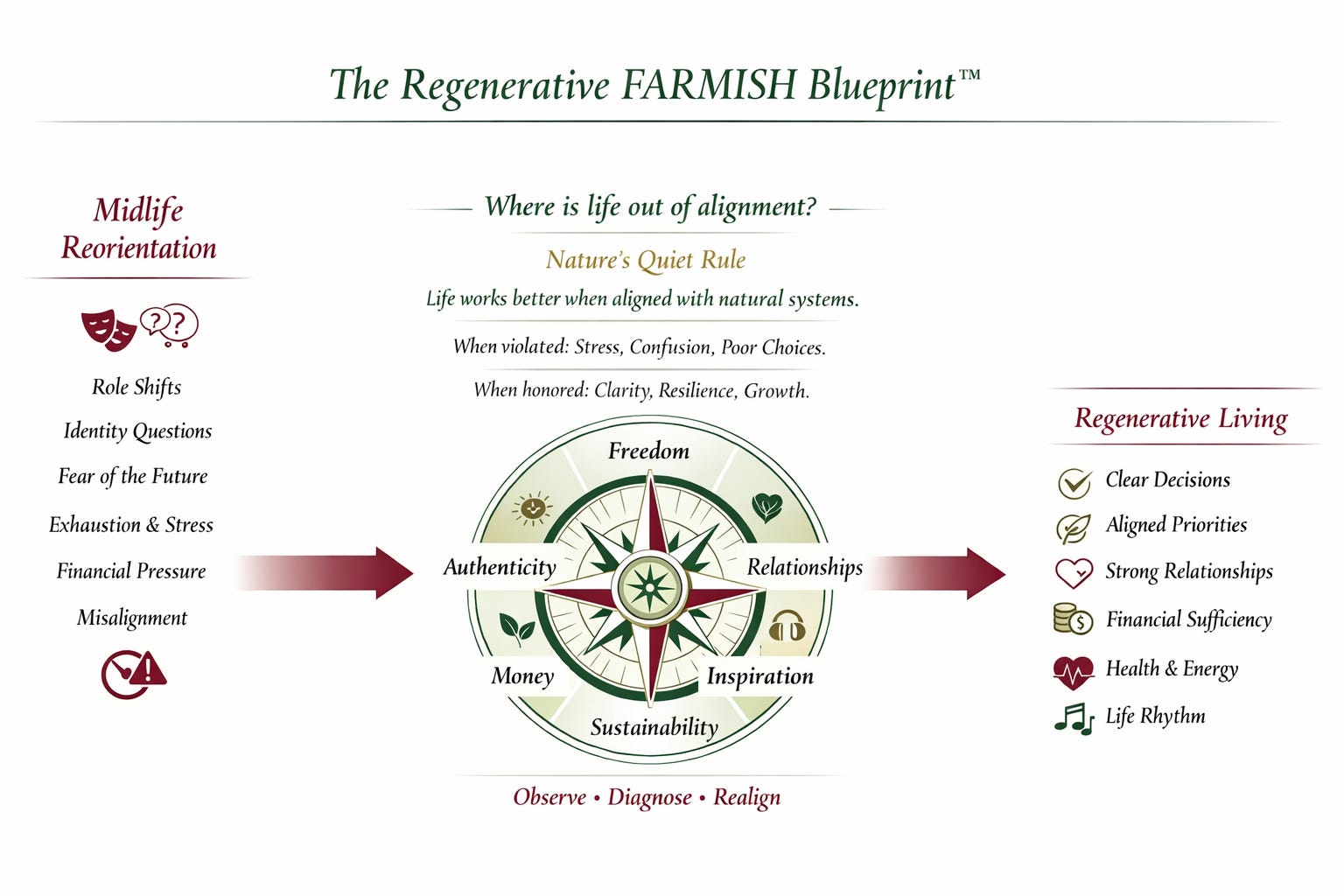
The framework I use with clients has a code for this exact pattern.
We call it Learned Helplessness, and it rarely sits alone. It travels with a second one we call Someone Else’s Dream, the slow handover of your judgment to experts, advisors, and authorities until the muscle that makes your own calls has not been used in years.
Every time you asked the specialist instead of yourself, every time you outsourced a decision that was yours to make - you got a small relief and paid a small tax.
The taxes compound. By the time the role disappears and you finally need your own judgment back, you reach for it and find it stiff from underusage.
The scarcity trap closes the loop
There is a third code that shows up here, and it makes all of the above worse. We call it Scarcity.
When a man loses his rank, he usually also feels the ground go thin under
his money,
his time, or
his options, whether or not the bank balance has actually changed.
And a mind in scarcity does a predictable thing: it narrows.
It tunnels in on the threat and loses the wide view that good decisions require. So the exact moment he most needs clear, calm, long-range judgment is the moment his biology is least equipped to produce it.
Cortisol up, testosterone down, control signal off, self-model in error, and now the aperture of attention closing to a pinhole.
It is a closed loop, and from inside it feels like proof that you are finished.
It is not proof of anything except that the loop is running.
Loops can be opened.

The compass problem
There is an old idea, older than any of this science, that the inside and the outside mirror each other.
As within, so without.
When a man’s inner order collapses, his outer life drifts, and the drift then looks like more evidence that the inner collapse is permanent.
Ouch!
A man who has lost the ability to decide small things stops steering the large things, and the large things wander, and the wandering frightens him further.
The part science keeps insisting on is this, and it is the whole turning point of this piece.
Nothing in your decision-making apparatus is broken.
The prefrontal cortex that detects control is intact. The capacity to make good calls is intact. What happened is that the structure feeding it the “you have control” signal was removed, and the system fell back to its default.
Worse even, the default feels like incapacity. The instrument still works. It stopped receiving power. That is a completely different problem, and it has a completely different solution.
Your judgment did not leave.
You handed it out, one default decision at a time, and then the room where you used to exercise it disappeared, and the muscle went quiet.
But quiet is not dead. Quiet is waiting for load.
No species survives against its code
I have spent twenty years watching living systems on a homestead, and the one law that has never once failed me is this:
no species can long-term live against its code.
A staked tree that is never allowed to move never grows the wood it needs to stand alone. Strength gets built by the load you are exposed to, and the stake removes exactly that load.
Remove all challenge from an organism and you do not get a stronger organism. Conversely, you get one that has lost the ability to meet challenges at all.
We have done this to ourselves at scale.
We have built a life of such total convenience that the human animal barely has to make a real decision from morning to night. Ridiculous is only the fact that then we are shocked when, in a crisis, the decision-making capacity is not there.
This is what I mean when I talk about human desertification.
A desert is not a place with no potential.
It is a place where the living systems that hold everything together have been stripped out, one by one, until the ground can no longer do what ground is supposed to do.
A man who has outsourced every decision for twenty years is a small, walking desert of the will. And deserts, given the right small interventions, regreen.
The FARMISH blueprint I work from puts this pain in one specific corner: Freedom.
The violated principle is simple. Freedom is a capacity you maintain by using it, the way a muscle stays a muscle only under load.
Stop deciding for yourself and the machinery of self-governance atrophies exactly like an unused limb. The good news lives in the same fact.
Because atrophied is not amputated!
You rebuild it the way you build any capacity that has gone soft. Small load, often, on purpose.
The way back is shorter than you think
Everything above points to one intervention, and it is almost insultingly small.
Make three decisions today that you do not run past anyone.
Not big ones. Trivial ones.
What you eat for lunch, chosen and eaten without checking whether it is optimal. What you wear, picked because you want to, not because it is correct.
What you do first when you sit down to work, decided by you and then simply done. Three of them.
Today.
This is the specific thing the neuroscience says rebuilds the machinery.
It is mechanical, not motivational. The prefrontal cortex learns control by experiencing control.
It cannot be argued into the “you have agency” state. It has to be shown, through repeated small acts where you decide and the deciding sticks.
Every trivial decision you make and follow through, with no outside sign-off, is one rep or exercise that tells the control detector: the signal is back, stand down the shutdown.
You are not choosing a sandwich. You are sending a status report to the part of your brain that governs whether you feel capable of anything at all.
Start trivial for a reason.
A man in the loser-effect state cannot begin with “decide whether to sell the house” or “choose your entire next chapter.”
The system is chemically tuned to retreat from large contests, and a large decision this early will simply confirm the helplessness.
You begin under the radar, below the level where the threat response fires!
With decisions so small that failure is meaningless and success is guaranteed. Then you let the reps accumulate. The control signal rebuilds the way it decayed.
Gradually, then all at once.
Here is my proof, and it is the only kind I trust.
The kind you have paid for yourself.
After my heart attack I could not decide if I wanted my window open or closed.
It was a horrible feeling.
In consequence of what I learned about my hesitation, I did not rebuild by making a grand plan for the rest of my life.
I rebuilt by choosing: small, deliberately and without consulting anyone. Simple things like what I would eat, when I would walk, what I would do with the first hour of the day.
Thirty kilos came off over the following years. The decisions got larger as the muscle came back.
The man who could not choose a temperature in a room now runs his own days entirely, and is in better shape at 59 than he was at 40. The capacity was never gone.
It was just waiting for load.
You will know it is working faster than you expect.
Watch for day five. Somewhere around the fifth day of making your three unconsulted decisions, you will catch yourself making a fourth one without noticing. Just as you always did before.
That small automatic decision, the one you did not have to force, is the control signal coming back online. That is your readout that the instrument still works.
Do not wait to feel confident before you begin. Confidence is downstream of the reps, not upstream. The chemistry follows the behavior, in that order, and never the reverse.
Awareness has to come before choice. You cannot rebuild a capacity you still believe is a character flaw.
So the first move, before the three decisions, is the one you just made by reading this far: seeing the fog for what it is. A readout, not a verdict.
A signal from an animal that lost its rank and is running its oldest program, waiting for you to give it the small, repeated evidence that you are still the one who decides.
If you want to see which corner your own version of this sits in, and which natural principle it is violating, then the Clarity Letter is for you.
And if today is one of these hard days, the short guide “When Every Option Feels Wrong” is free and built for precisely the state this piece describes.
You do not need either one to start.
You need a sandwich you chose yourself. But when you are ready to map the whole thing instead of just the fog, the door is open.
Let’s regenerate the world, starting with yours.
Daniel
Regenerative Life and Business Consultant
Sources and further reading
- Sapolsky, R. M. Decades of work on rank and glucocorticoids in wild olive baboons, Amboseli. Overview: *Life at the Top: Rank and Stress in Wild Male Baboons*, Gesquiere et al., Science, 2011. https://pmc.ncbi.nlm.nih.gov/articles/PMC3433837/
- Sapolsky, R. M. *Are Subordinates Always Stressed? A Comparative Analysis of Rank Differences in Cortisol Levels Among Primates.* https://www.researchgate.net/publication/10875215
- Social rank, cortisol and testosterone in male cynomolgus monkeys. https://pmc.ncbi.nlm.nih.gov/articles/PMC2709846/
- Wingfield, J. C. et al. *The Challenge Hypothesis: Theoretical Implications for Patterns of Testosterone Secretion, Mating Systems, and Breeding Strategies.* Overview: https://www.sciencedirect.com/topics/neuroscience/challenge-hypothesis
- Maier, S. F. and Seligman, M. E. P. *Learned Helplessness at Fifty: Insights from Neuroscience.* Psychological Review, 2016. https://pmc.ncbi.nlm.nih.gov/articles/PMC4920136/
- Roelfs, D. J. et al. *Losing Life and Livelihood: A Systematic Review and Meta-Analysis of Unemployment and All-Cause Mortality.* Social Science & Medicine, 2011. https://pmc.ncbi.nlm.nih.gov/articles/PMC3070776/
- On the male mortality gap in unemployment and identity centrality. https://www.sciencedirect.com/science/article/abs/pii/S0277953612001657
- Predictive self-model / the self-evidencing brain: Hohwy, J. https://philarchive.org/rec/HOHTSB-2 and *Prediction-based neural mechanisms for shielding the self from existential threat.* https://www.sciencedirect.com/science/article/abs/pii/S1053811919306688
- On gray divorce and its consequences: *The Economic Consequences of Gray Divorce for Women and Men.* https://pmc.ncbi.nlm.nih.gov/articles/PMC8599059/