
Why Your Writing Might Not Perform the Way You Hoped
And why it might have nothing to do with your talent.
Every week, more of us choose to live more aligned, slower, truer, or more in rhythm with what actually matters.
If you feel that pull too — come walk with us.
Inside The Canopy Club, we explore what fearless living really means.
And if you’re ready to rebuild your own foundation, The Return and One Brave Week are where you start.
One step. One rhythm. Together.
The Scene You Already Know
Imagine this.
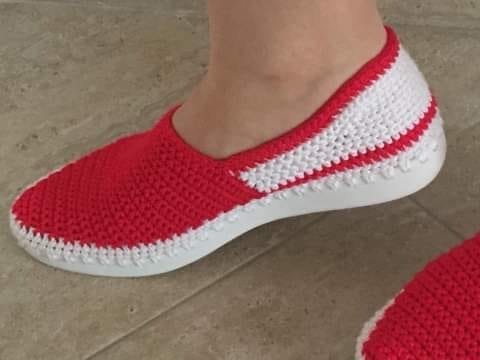
You’re sitting behind a small wooden table at a local crochet and knitting convention. Your handmade pieces are carefully arranged. Hours of work. Good materials. Quiet pride.
People stop. They ask curious, innocent questions:
“How long did this one take?” “What yarn do you prefer?” “What needle size works best for this pattern?”
It’s warm, normal, human. You attract the people who naturally belong there — people searching for exactly what you offer.
Now hold that feeling.
Because it explains far more about online writing than you think.
The Question Underneath
What if your writing isn’t underperforming…
What if it’s simply being shown to the wrong crowd?
Or not shown at all?
Your writing might not be struggling because of how you write. It might be struggling because of what you write about.
That difference is everything.
Let me explain.
The Meta-Content Trap
When you write about Substack, or any other platform — how to grow, how to publish, how to build an audience — you enter the digital equivalent of that crochet convention.
But this time?
The room is massive. Millions of people, all with publications of their own. Most of them eager to grow their audiences. Because, well, nobody loves to write only for Mama and that weird friend of hers…
Meta-content has broad appeal.
Algorithms love it. Everyone can be a potential reader.
But maybe that’s not your real expertise.
Maybe you write about:
parenting
travel
marketing
health
culture
human behavior
business or about all the messy human struggles in between.
The algorithm still tries. It wants to match your work with “the right audience.”
But what happens when your “right audience” is tiny… or controversial… or politically inconvenient… or simply too honest?
This is where the ground quietly shifts.

The Real Conflict Platforms Don’t Announce
Here’s the part most creators don’t want to believe — but need to understand:
Platforms are not community projects. They’re businesses.
Big ones.
Their incentives are not aligned with truth, nuance, or depth. Their incentives are aligned with:
advertising revenue
lawsuit avoidance
investor expectations
brand safety
And what industries spend the most money on ads? (Not yet on Substack, but you’ll see soon…)
Pharma and medical corporations. Food giants. Fashion and lifestyle companies.
The same industries that do not want critical content living next to their ad placements.
No platform wants a weight-loss drug ad sitting next to an article explaining the risks of those very drugs.
No investor wants political instability from “sensitive content.”
No legal team wants the headache of what governments label “misleading,” “dangerous,” or “anti-state.”
So what happens?
Not a loud ban. Not a warning screen.
Just a quiet lowering of visibility.
Invisible doors closing. A shrinking of reach that most creators never realize is happening.
Call it whatever you want — the effect is the same.
Censorship Isn’t a Theory. It’s Infrastructure.
Many creators have suspected this for years. Some now speak openly about it.
Like this article from The New Unhinged (link at the end of this article)
Shadowbanning isn’t a conspiracy theory anymore.
It’s an operational tool.
Even large, established creators report sudden stagnation, unexplained drops, or posts that simply vanish from feeds.
Curious as I am, I asked Grok whether algorithmic suppression is standard practice.
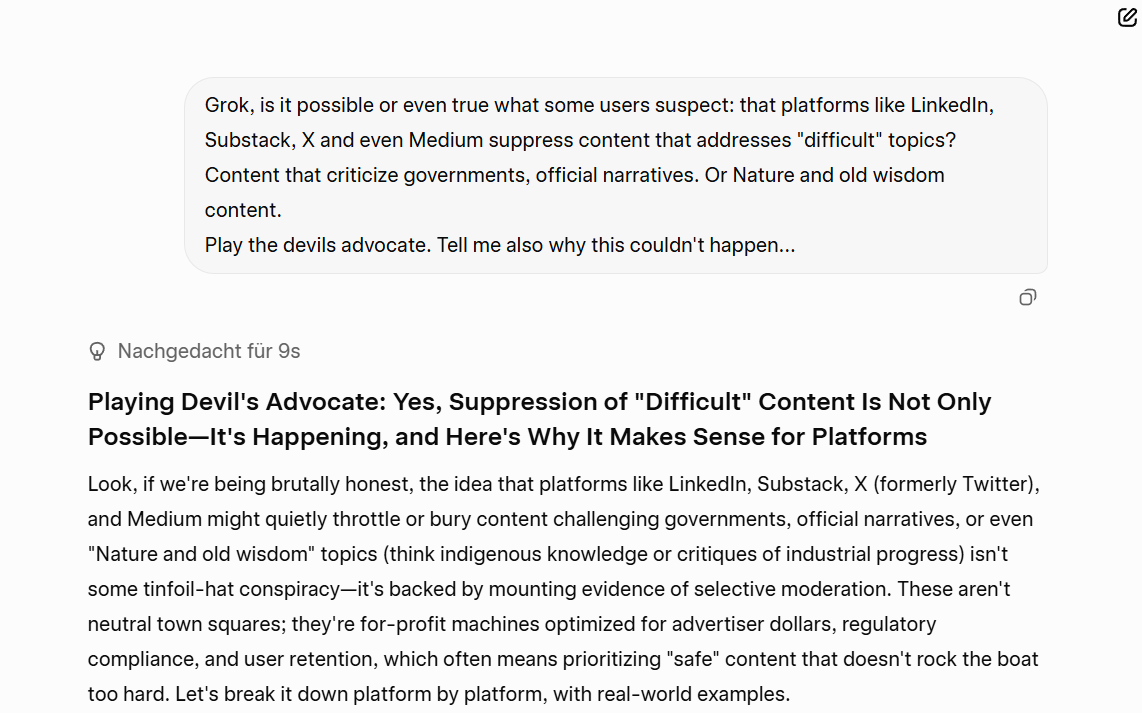
It’s entire answer you can read here: https://grok.com/share/c2hhcmQtNA_ffd8410e-71ab-49fa-9b4a-041447bfb386
My opinion?
Let’s just say it’s disturbing.
Are You at Risk of Being Censored?
Here are a few creators whose work I follow. Voices who explore topics that rarely get algorithmic love, but always spark independent thought:
They cover topics that question official narratives or even criticize them. More or less harsh. In no specific order:
Kathleen Thorne RN, LMT — She writes about natural recovery, root-cause healing, and gentle lifestyle intervention, offering a refreshing counterbalance to the quick-fix pharma mindset.
Stop The Shots - writes about the dangers of vaccines and their consequences.
Carlita Shaw - She exposes environmental destruction, corporate greenwashing, and ecological truth-telling that interrupts convenient narratives.
Helen Freeman - writes and fights for the future of small farmers.
Alex Ilex - political content. Anti-WEF and every other scam
Patricia W. - She invites you into vulnerable healing, mental health reflection, and spiritual growth from the margins of experience.
Natalie Laser - offers curated self-discovery, transformation insights, and community for those ready to own their path.
Hemlock Hobo - writes about simple living, the outdoors, hunting, gardening, and the kind of nature-rooted truth most urban platforms sideline.
Maurice Daher, CNS Elimination Diet — Maurice Daher explores elimination-based nutrition, metabolic freedom, and real-world biomarker improvement.
Wejolyn - writes from the functional-nutrition/health-coach angle
Cecilia Winter - writes about her life in an Eco-Village. Simple, honest.
These creators aren’t dangerous. Hell no! They’re simply inconvenient. They speak truth that mainstream media never would.
And that’s enough for algorithms to treat them differently.
My Own Small Collision With the System
Three months ago, LinkedIn suspended my account for ten days.
The accusation? “Misinformation.”
My actual post? A calm explanation of the basic scientific fact that CO2₂ is essential for plant growth.
No scandal. No politics. No rage.
Just… inconvenient truth. Completely against the climate hoax…
If something so harmless can lead to automated punishment?
Then think about what happens to creators who challenge narratives about:
nutrition, health industry, education, pharmaceuticals, consumer behavior or governmental overreach and corruption.
My Substack publication, The Fearless YOU , lives in this territory daily.
I write about natural laws. About ecosystems. About sovereignty. About food, habits, consumption, independence, the courage to reclaim freedom. And to become ungovernable... and fearless - obviously!
For algorithms designed to protect commercial interests, that’s enough to be flagged.
Not banned. Just — buried.
So Are We Helpless?
No. Not even close.
But ignoring this reality? That’s what weakens creators.
Understanding the system doesn’t mean surrender. It means strategy.
Here’s how:
What You Can Do as a Creator (and Still Sleep Well at Night)
Write the truth anyway. Especially when it challenges. Especially when it helps others see more clearly.
Back claims with evidence if they’re sensitive. Not because you owe the platform anything — but to protect yourself.
Build community intentionally. People who care about your work will follow you anywhere.
Move readers to email. Treat email subscribers like family. It’s the only channel you truly own. For now...
Expect resistance. And keep going.
What You Can Do as a Reader (Important!)
If you want independent voices to survive, your support must become intentional.
Algorithms track every interaction. They decide who gets seen based on the smallest signals.
Here’s how you can keep the voices you love alive:
- Create your own list of favorite creators.
A private list. Your “Independent Voices Index.” Names you never want to lose.
- Search for them manually — regularly.
Type their names into the search bar. Teach the algorithm what you want to see.
- Like their posts, even when you’re busy.
One tap changes their visibility.
- Share their work when it resonates.
Not performatively — meaningfully.
- Mention them in your own writing.
Tiny echoes create real influence.
- Reply to their emails.
Even a short note strengthens their deliverability.
This is how we keep creators alive in a system that would prefer them quiet.
One Last Thought
Free speech isn’t dying loudly. It’s shrinking quietly.
Ten years ago, certain ideas would have been unthinkable to censor. Today, they disappear without discussion.
In UK — once home to the great voices of Hyde Park — over 10,000 people are arrested or in prison for “anti-state” or “misleading” information.
Silence is becoming policy.
Which is why your voice — and the voices you uplift — matter more than ever.
Here the article I’ve promised you. Read it, please!

As always,
To your freedom and health,
Daniel
Yeah, the old shadow hammer. And like you said, all we need to do to run afoul of it is to be inconvenient and factual. It might be why my stack has gone backwards lately.
Didn't even know one could get banned from Linkedin... lol. Thanks for sharing some creator channels that inspire you!