

You Asked the Expert. Your Brain Stopped Doing the Math.
Someone else’s dream: how twenty years of second opinions taught your judgment to stop showing up.
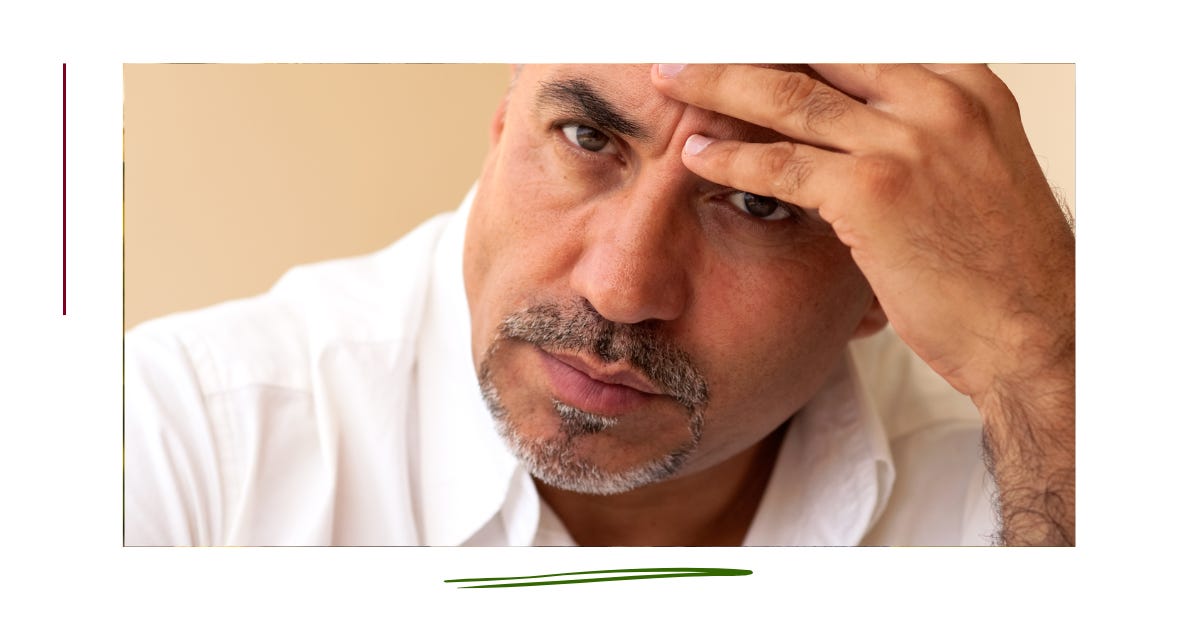
You’re sitting somewhere familiar.
The coffee’s there. The day has started. And yet something isn’t.
You’ve done everything right by anyone’s standard. But the question that keeps surfacing, the one you dismiss before breakfast, isn’t going away.
I write about that question. Every week. For people in midlife who’ve stopped pretending it isn’t there.
If that’s you, you’re in the right place.
A man sits at his kitchen table at half past ten after dinner.
With a decision that is three weeks old.
He has asked his brother-in-law.
Read a forum thread from 2019. Asked his accountant, who gave him a number and no opinion. (That’s what they do usually, right?)
Tonight he types the whole thing into his preferred AI chat window and reads what comes back. And it says roughly what he thought in the first week.
He does not decide. Just not yet. He opens another tab instead.
To be sure!
In case you have your doubts. Yes, his intelligence is fine.
He ran a business for many years. The decision in front of him is his; every answer he has collected belongs to somebody else!
He has been collecting for so long that the collecting has become the decision.
I know that table from the other side.
I trained as a financial advisor, which means I was taught how to be the person whose answer ends the discussion.
Most of that training is about confidence and delivery. Nobody taught me then what the answer costs the person receiving it. As I learned later in life, there’s a price to pay. We’re talking about it in a minute.
The relief tax
This here stays hidden, because it often feels good.
When you hand a decision to someone with more authority than you, something heavy leaves the room. The proverbial “heavy stone on the heart”. Gone.
That relief is real and it is immediate. It is also the price tag, and you have been paying it in small installments since roughly 1998… (!)
Every time you asked instead of decided, you got the relief. And the machinery that makes your own calls got one more session off.
Twenty years of small relief. That is the whole mechanism.
There is usually no dramatic moment when we, as men, lose our judgment. There is a Tuesday in 2011 where we ask our boss about something we could have decided ourselves. Gosh, it goes well, and nothing bad happens.
And that is exactly the problem.
In the FARMISH blueprint™, this pattern is numbered.
It is F12, Loss of Self-Trust in Decision-Making, and it sits in the Freedom corner. It travels with F9, Learned Helplessness, which is the state I wrote about in When a Man Loses His Rank:

It’s about the fog that arrives when a role disappears. It explains why the fog shows up.
This one here explains why, when you reach for your own judgment to get out of it, you find it stiff.
What the scanner saw
In 2009, a team at Emory put 24 people in an fMRI scanner and had them make financial choices. A certain payment, or a lottery. Seven different probability conditions.
On half the trials, advice from an expert economist appeared on the screen.
On the other half, nothing.
Two findings, and the second one is the one to sit with.
When the expert’s advice was on the screen, activity dropped across the regions that compute the value of options. In the authors’ own words: one effect of expert advice is to “offload” the calculation of value of decision options from the individual’s brain.
The expert’s advice was deliberately suboptimal. It followed a rough rule of thumb rather than the actual best strategy. Guess what? People followed it anyway.
Read those two together.
The quality of the advice had nothing to do with whether the brain handed over the work. The handover happened because an authority was present. Good advice and mediocre advice produced the same shutdown.
Why? Because the shutdown is a response to the authority, not to the argument.
You have been in that scanner for twenty years. Just in a different chair…
The chair got more comfortable this year. It answers in two seconds now; it never looks tired of the question, and it is available at half past ten at night. Open source and mostly free.
The root that stops working
I have watched this exact law operate in soil for two decades. In plants, it is settled agronomy.
A bean plant does not need fertilizer to get nitrogen.
It builds nodules on its roots, houses bacteria inside them, and pulls nitrogen straight out of the air. The arrangement is expensive.
The plant pays in sugar, constantly, to keep those bacteria fed.
Now give that plant nitrogen fertilizer.
Within a short time the nodules stop forming and the ones that exist stop fixing.
A 2017 review in the Journal of Experimental Botany puts it in one line: the application of N fertilizer quickly inhibits both the formation and N fixation activity of nodules.
The reason is not damage. The plant is doing arithmetic. Nitrogen is arriving for free, so it stops paying the sugar bill for the machinery that makes its own.
That is a healthy plant making a rational choice. Simple, logical.
It is also a plant that, if the fertilizer stops, is standing in a field with no nodules.
No species can long-term live against its code.
And the consequence is this:
A capacity you stop paying for is a capacity you stop having.
Nobody bills you for twenty years
The compounding is the part men underestimate, so here is a measured version of it.
In 2020, two researchers at McGill published a study on GPS use and spatial memory. Across 50 people, more lifetime GPS use went together with worse spatial memory when they had to navigate on their own.
Then 13 of those people came back about three years later. In that smaller group, more GPS use during those three years went with a steeper decline in exactly the kind of memory that GPS replaces.
Fascinating!
Thirteen people is a small number and the authors say so themselves. They are careful about causation and I will be too.
Take it as one measurement pointing the same direction as the beans and the scanner:
The function that stops being used stops being available, and the bill arrives years after the convenience did.
Nobody sends you an invoice for the second opinion you asked for in 2011. That is the design flaw.
If the fee arrived the same day, you would have noticed the total.
The week that shows you the number
Awareness has to come before choice.
The corner this sits in
Freedom. (The letter F from FARMISH)
The violated principle is the one this whole piece runs on: awareness precedes choice. You cannot rebuild a capacity while you still believe it is a character flaw, and you cannot see it as a capacity until you have counted it.
My own proof is smaller than any framework.
After my heart attack at 51, I could not decide whether I wanted the hospital window open or closed.
I rebuilt my life from there by deciding what I would eat, when I would walk, and what I would do with the first hour of the day.
Without asking anybody whether it was optimal. Thirty kilos came off over the following years. The judgment was never gone. It just had nothing to do.
If you want to see which of the seven corners your own version of this is sitting in, and which natural principle it is breaking, take the Drift Check

You get your personalized result in about three minutes.
And nobody has to know you took it.
Let’s regenerate the world, starting with yours.
Daniel
Sources
- Engelmann, J. B., Capra, C. M., Noussair, C., Berns, G. S. *Expert Financial Advice Neurobiologically “Offloads” Financial Decision-Making under Risk.* PLoS ONE, 2009. https://journals.plos.org/plosone/article?id=10.1371/journal.pone.0004957
- Murray, J. D., Liu, C.-W., Chen, Y., Miller, A. J. *Nitrogen sensing in legumes.* Journal of Experimental Botany 68(8), 2017, 1919-1926. https://academic.oup.com/jxb/article/68/8/1919/2645554
- Dahmani, L., Bohbot, V. D. *Habitual use of GPS negatively impacts spatial memory during self-guided navigation.* Scientific Reports 10, 6310, 2020. https://www.nature.com/articles/s41598-020-62877-0
- Risko, E. F., Gilbert, S. J. *Cognitive Offloading.* Trends in Cognitive Sciences 20(9), 2016. (Background reading on the general mechanism; not cited in the body.) https://www.sciencedirect.com/science/article/abs/pii/S1364661316300985
Daniel, “the collecting has become the decision” is the part I would carry into any conversation about AI and expert counsel. Advice can expand the field of view while decision ownership remains with the person who will live with the consequence. Once consultation becomes a way to defer closure, the tool, advisor, or additional opinion starts occupying authority that judgment was meant to exercise. I appreciate how directly you connected self-trust with the discipline of eventually making the call.